Circular Motion
Overview
Circular Motion is the study of motion along a circular path. Although an object may move with constant speed, its velocity usually changes continuously because velocity is a vector quantity with both magnitude and direction.
Everyday examples include:
- spinning discs
- Ferris wheels
- washing-machine tubs
- satellite orbits
- roller-coaster loops
Therefore, circular motion commonly involves:
- changing velocity
- acceleration toward the centre
- a resultant inward force
Linear kinematics alone is not enough, because circular motion is often described more naturally by:
- angular displacement
- angular velocity
- period
- frequency
- the link between tangential motion and angular motion
This topic connects ideas from:
For deeper treatment, see:
- Centripetal Acceleration and Force
- Circular Motion Force Analysis
- Vertical Circular Motion
- Orbital Motion in Gravity
Core Ideas
Topic 7 is built around four linked ideas:
- Circular motion has a geometric description in terms of radius, arc length, and angular displacement.
- Uniform circular motion may have constant speed but still has changing velocity, so acceleration exists.
- The required inward acceleration is centripetal and is produced by a resultant inward force.
- Most application questions reduce to careful force analysis, and vertical-circle questions often also require energy conservation.
What Is Circular Motion?
An object undergoes circular motion when it moves along a circular path of radius .
Examples:
- car turning around a bend
- stone tied to a string
- rotating fan blade tip
- satellite in orbit
- roller coaster loop
Circular motion may be:
- Uniform circular motion: speed remains constant
- Non-uniform circular motion: speed changes
Scalar vs Vector Distinction
This chapter requires careful distinction between scalars and vectors.
Scalars
- distance
- speed
- time
- radius
- period
- frequency
Vectors
- displacement
- velocity
- acceleration
- force
Important Reminder
A particle may move with constant speed but changing velocity because direction changes.
That is why uniform circular motion still has acceleration.
Angular Motion Quantities
Angular Displacement
Angular displacement is the signed angle swept out by a rotating object at the centre of the circle. By convention, the anticlockwise direction is usually chosen as positive.
Using the right-hand grip rule, if the fingers of the right hand curl in the positive direction of rotation, the thumb points along the positive axis of rotation. For anticlockwise rotation in the plane of the page, this positive axis points out of the page.
Thus, in a two-dimensional diagram, anticlockwise angular displacement is usually taken as positive, while clockwise angular displacement is taken as negative.
It is measured in radians.
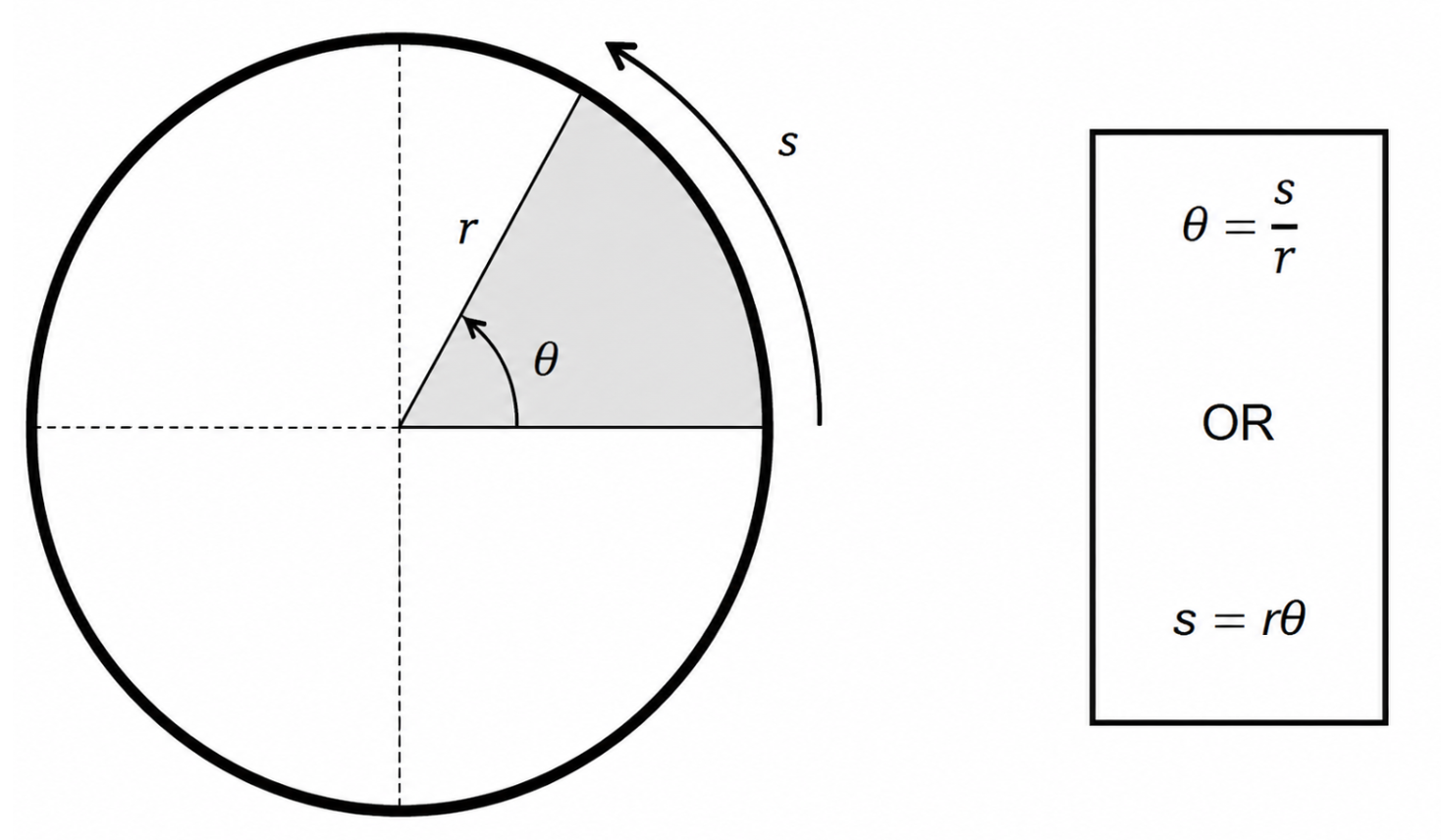
Figure 1. Angular displacement is defined at the centre of the circle, and the anticlockwise arrow makes the positive direction explicit.
The radian is defined so that:
- one radian is subtended by an arc whose length equals the radius
- radian measure must be used in circular-motion formulae such as
For arc length :
Hence:
Angular Velocity and Angular Speed
In vector language, angular velocity is written as . Its direction is perpendicular to the plane of circular motion and is determined by the right-hand rule.
For motion in the plane of the page, anticlockwise rotation corresponds to pointing out of the page, while clockwise rotation corresponds to pointing into the page.
In most H2 circular-motion questions, we usually work with either the magnitude or a signed scalar convention in a fixed plane:
- anticlockwise positive
- clockwise negative
With this convention, the signed angular velocity is the rate of change of angular displacement:
Angular speed is the magnitude of angular velocity:
For uniform circular motion, the angular velocity is constant:
so:
For one full revolution:
The time taken for one full revolution is the period . Hence:
or equivalently:
Since frequency is the number of revolutions per unit time,
therefore:
where:
- = period
- = frequency
If the motion starts from rad, then after time :
Speed and Tangential Velocity
The linear speed of an object moving in a circle is:
Where:
- = speed (scalar)
- = radius
- = angular speed
If discussing the vector velocity :
- direction is always tangent to the circular path
- magnitude is
- is always perpendicular to the instantaneous radius vector
Direction of Key Vectors
For uniform circular motion:
Velocity Vector
- tangent to path
- perpendicular to radius
Centripetal Acceleration Vector
- points toward centre
- is always perpendicular to in uniform circular motion
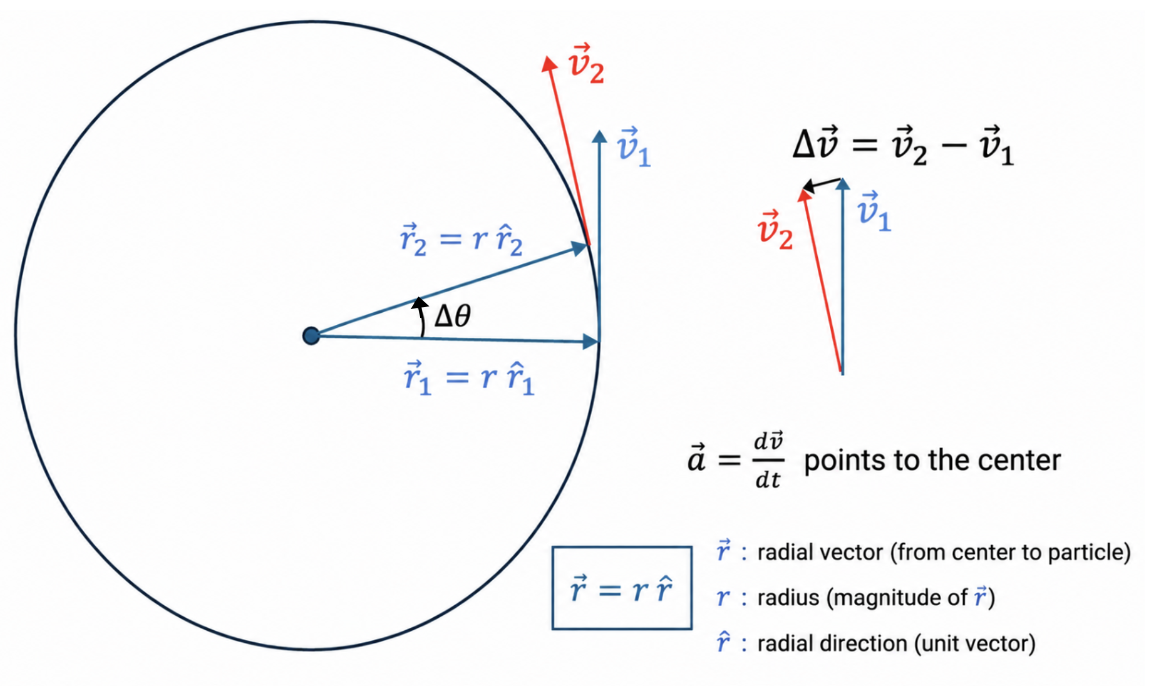
Figure 2. In uniform circular motion, as the velocity changes from to , the speed remains constant but the direction of velocity changes. For a small angular displacement , the change in velocity points approximately inward. In the limit as , the instantaneous centripetal acceleration points exactly towards the centre of the circle. Thus, even though the speed is constant, the velocity is changing, so the object has a centripetal acceleration directed towards the centre.
Resultant Force Vector
By Newton’s second law of motion, the existence of centripetal acceleration implies that there must be a resultant force in the same direction:
For uniform circular motion, points towards the centre of the circle. Therefore, the resultant force also points towards the centre:
where is the centripetal resultant force.
Important:
- centripetal force is not an extra force;
- it is the resultant inward force provided by real forces such as tension, friction, weight, normal contact force, or gravitational attraction.
Centripetal Acceleration Overview
Because direction of velocity changes, acceleration exists even if speed is constant.
In vector form:
and equivalently:
where is the radius and is the outward radial unit vector, so the negative sign shows that points inward.
Magnitude:
Also:
Direction:
- always toward centre of circular path
See Centripetal Acceleration and Force.
Centripetal Force Overview
Using Newton’s Second Law:
Along the inward radial direction, the corresponding magnitude relation is:
or
Important Warning
“Centripetal force” is not an extra new force.
It is the resultant inward force provided by real forces such as:
- tension
- friction
- normal contact force
- gravitational force
- electric force
- lift
In uniform circular motion, the centripetal force does no work because it is always perpendicular to the instantaneous displacement and perpendicular to .
This means the centripetal acceleration in circular motion is the consequence of the vector resultant of all real forces acting on the object:
Along the inward radial direction, this becomes the scalar working form:
Basic Force Analysis Overview
In circular motion questions:
- Identify the object
- Draw all real forces
- Choose radial inward direction
- Resolve forces if needed
- Apply:
See Circular Motion Force Analysis.
Two Common Reasoning Workflows
- Known motion resultant inward force missing real force or force component.
- Known real forces resultant inward force centripetal acceleration missing motion quantity such as , , , , or .
In other words:
- if the motion is known, use it to infer the required inward resultant
- if the forces are known, use them to infer the motion they can sustain
Horizontal Circular Motion (Brief Overview)
Examples:
- car turning on flat road
- conical pendulum
- rotating platform
- banked track
Often, speed may remain constant while force direction changes continuously.
Possible inward forces:
- friction
- tension
- horizontal component of normal force
- horizontal component of tension
Standard Strategy
- Identify the object undergoing circular motion.
- Draw only the real forces.
- Choose the inward radial direction.
- Use vertical equilibrium where appropriate.
- Use the radial resultant equation:
Typical H2 cases include:
- conical pendulum
- banked aircraft
- banked road or track
- artificial gravity in a rotating habitat
- rotating cylinder or drum ride

Figure. Horizontal circular-motion problems are unified by the same idea: draw only the real forces, then identify which component provides the inward radial resultant.
See Horizontal Circular Motion and Circular Motion Force Analysis.
Non-Uniform Circular Motion (Brief Note)
If the speed changes during circular motion, the acceleration no longer points purely towards the centre. Instead, it has two components:
Radial Component (Centripetal)
The radial component points towards the centre:
where is the radially outward unit vector. The negative sign shows that points radially inward, towards the centre.
Tangential Component
The tangential component acts along the tangent to the circular path and is due to the changing speed:
where is the unit vector in the direction of motion.
Hence, the resultant acceleration is:
and the resultant force is not purely centripetal:
The resultant force can also be decomposed into radial and tangential components:
where:
and
Only brief awareness of this distinction is needed at H2 level.
Energy Methods (Brief Note)
For vertical circular motion, speed often changes with height.
Use conservation of mechanical energy:
Then combine with circular-force equations.
See:
Vertical Circular Motion (Brief Overview)
Vertical circular motion differs from many horizontal-plane problems because the speed is often not constant.
Why:
- the height changes
- gravitational potential energy changes
- the radial-force balance changes with position
The top and bottom of the circle are usually the most important positions.
Typical H2 cases include:
- car moving over a hump
- bucket of water
- roller-coaster loop
- loop-the-loop minimum-height problem
At the limiting condition for just maintaining contact at the top of a smooth loop:
so the inward radial condition becomes:
hence:
Energy conservation then links this critical top speed to the required release speed or release height.
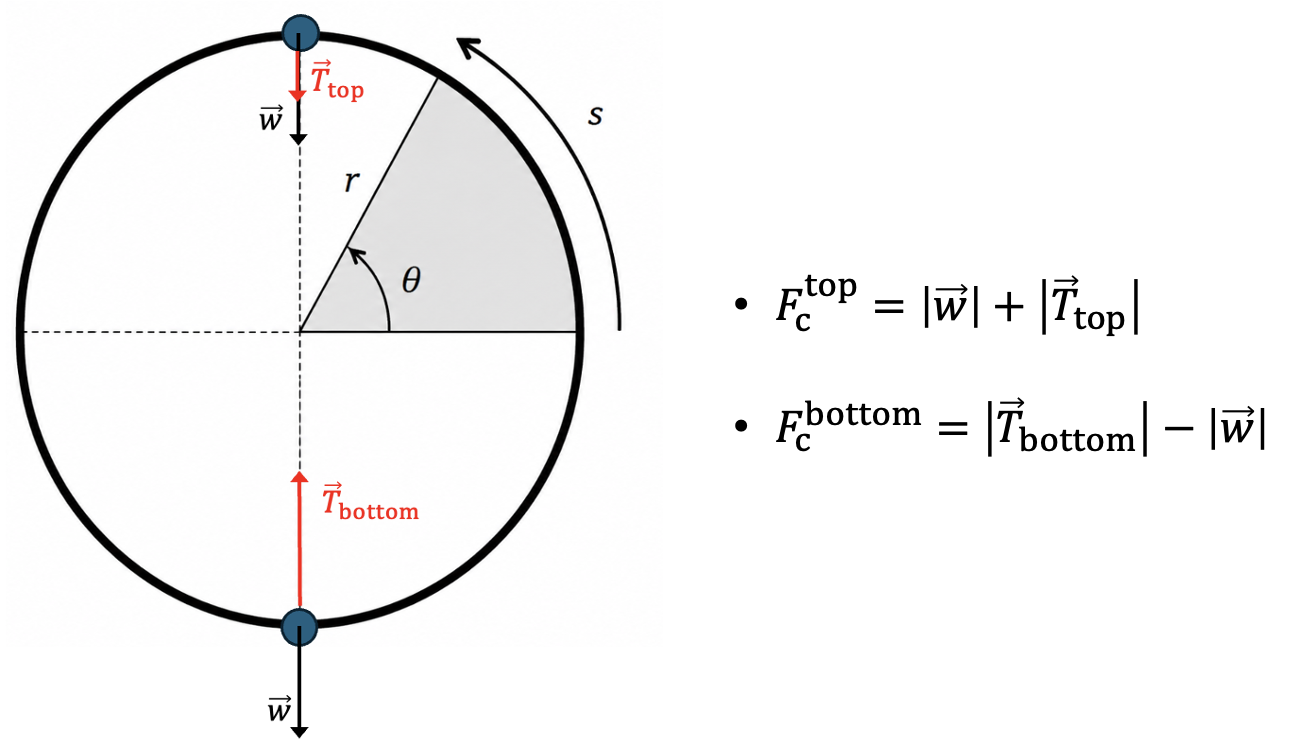
Figure 3. For an object tethered by a string and moving in a vertical circle, the two real forces are the tension and the weight . Their vector sum gives the inward centripetal resultant, which points toward the centre at each position.
See Vertical Circular Motion and Energy and Problem Solving in Circular Motion.
Worked Example 1: Angular Speed
A wheel rotates at frequency .
Find angular speed.
Solution
Worked Example 1A: RPM to Angular Speed
A washing-machine tub spins at .
Convert this to angular speed.
Solution
Worked Example 2: Centripetal Acceleration
A car moves at around a bend of radius .
Find centripetal acceleration.
Solution
Worked Example 3: Resultant Force
A car from Example 2 moves around the bend.
Find resultant inward force.
Solution
Toward the centre.
Formula Summary
Angular Motion
Linear and Angular Relation
Centripetal Acceleration
Centripetal Force
Exam Relevance
1. Confusing Speed with Velocity
Speed can be constant while velocity changes.
2. Treating Centripetal Force as Extra Force
Wrong. It is the resultant inward force.
3. Wrong Direction of Velocity
Velocity is tangent to path, not toward centre.
4. Wrong Direction of Acceleration
For uniform circular motion, acceleration is toward centre.
5. Forgetting Force Resolution
Only inward radial components contribute to centripetal requirement.
6. Mixing Period and Frequency
7. Forgetting That Centripetal Force Does No Work
In uniform circular motion, the inward force is perpendicular to the instantaneous displacement, so it changes the direction of but not the speed.
Mathematical Derivation Enrichment
For uniform circular motion in the -plane, a convenient position model is:
Differentiating gives the velocity components and then the acceleration components, leading back to:
and
See Circular Motion Mathematical Derivations.
Practice Patterns
Common exam patterns include:
- rpm to
- angular speed, period, and frequency conversion
- linear speed and centripetal acceleration on a turntable
- conical pendulum
- banked track or aircraft turn
- orbital speed and orbital acceleration
- hump, bucket, and loop-the-loop conditions
Links
- Circular Motion Core Concepts
- Centripetal Acceleration and Force
- Circular Motion Force Analysis
- Horizontal Circular Motion
- Vertical Circular Motion
- Energy and Problem Solving in Circular Motion
- Circular Motion Mathematical Derivations
- Orbital Motion in Gravity
- Dynamics
- Work, Energy and Power
- Gravitational Fields
- Vectors