Work, Energy, and Power
Overview
This chapter connects ideas from Forces, Dynamics, Kinematics and Vectors.
Instead of analysing motion only through forces and acceleration, many problems can be solved efficiently using energy methods.
Core ideas:
- Work is energy transferred by a force acting through a displacement.
- Energy is a scalar quantity associated with motion, position or configuration.
- Power is the rate of energy transfer.
- Efficiency measures useful output compared with total input.
This page is the main revision hub for the chapter.
Core Ideas
Work-energy-power questions are easier when you distinguish clearly between:
- vectors such as force, displacement, and velocity
- scalars such as work, energy, power, and efficiency
- object-only systems, where external net work changes kinetic energy
- extended systems, where energy may be stored as potential energy within the system
Scalar and Vector Distinction
Be precise.
Vector quantities
- Force:
- Displacement: often denoted by or
- Velocity:
- Acceleration:
Scalar quantities
- Work:
- Energy:
- Power:
- Speed
- Mass
Although work depends on vectors, work itself is scalar.
What Is Work?
Work done by a constant force is defined using the dot product:
Magnitude form:
where:
- = magnitude of force
- = magnitude of displacement
- = angle between and
Unit:
Positive, Negative and Zero Work
Positive Work
Force has a component in direction of motion.
Examples:
- pulling a trolley forward
- gravity acting on a falling object
Negative Work
Force opposes motion.
Examples:
- friction
- drag
- braking force
Zero Work
Force perpendicular to displacement.
Examples:
- centripetal force in uniform circular motion
- carrying a bag horizontally at constant height
One-Dimensional Signed Forms
After choosing a positive direction, scalar signs may be used for force and displacement:
where and may be positive or negative according to direction. One dimensional displacement is also frequently indicated by change of position such as in this wiki.
However, remember that force and displacement are fundamentally vectors.
Work Done () by Gravitational Force
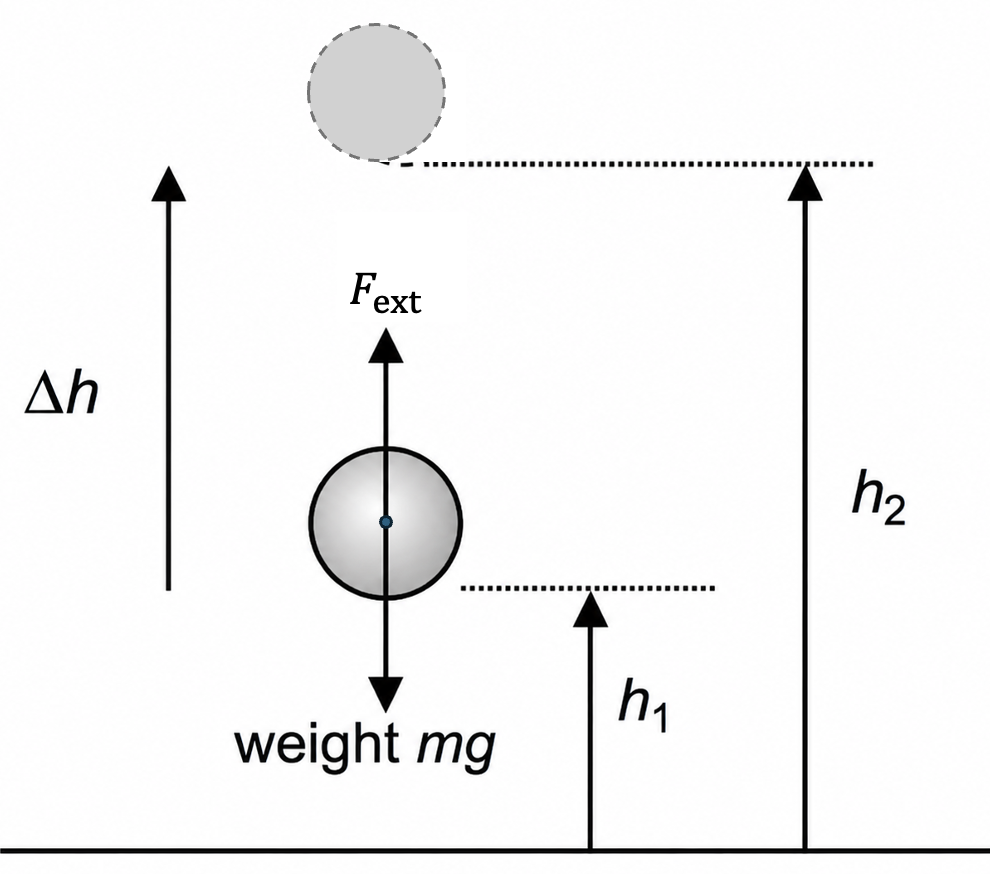
Using a one-dimensional signed scalar convention (upward taken as positive):
- Gravitational force: , where
- Vertical displacement:
- Work done by gravity:
- Work done by an external force to rise the ball without acceleration ():
Sign Interpretation
- Downward motion: , force and displacement are in the same direction, so
- Upward motion: , force opposes displacement, so
Physical Meaning
- : energy is transferred to the object → kinetic energy increases
- : energy is transferred from the object → kinetic energy decreases
Example: Free Fall
For a freely falling object (neglecting air resistance): , so gravity does positive work and the object’s kinetic energy increases.
Work Done () by Elastic Spring
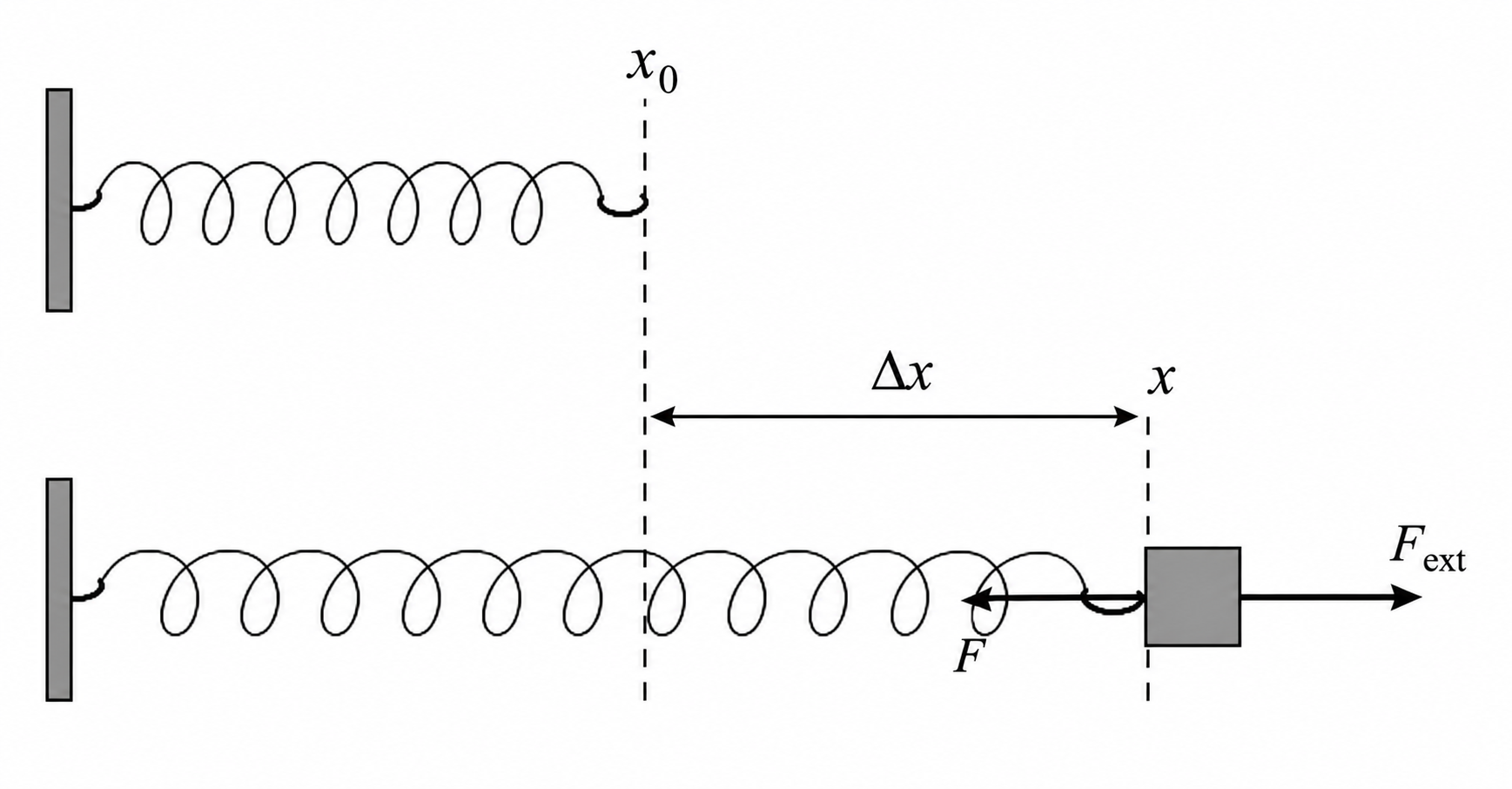
Using a one-dimensional signed scalar convention:
-
Spring force: , where is the extension from equilibrium position , and is the spring constant
-
: spring is extended; : spring is compressed
-
Work done by the spring force:
-
If setting : .
-
If extending the spring with an external force without acceleration (e.g., ), the work done by the external force: .
Sign Interpretation
- If the spring returns toward equilibrium: (spring does positive work)
- If the spring is stretched/compressed further: (external agent does work against spring force)
Physical Meaning
The spring force transfers energy between kinetic and elastic potential energy:
, where
Work Done by Expanding Gas
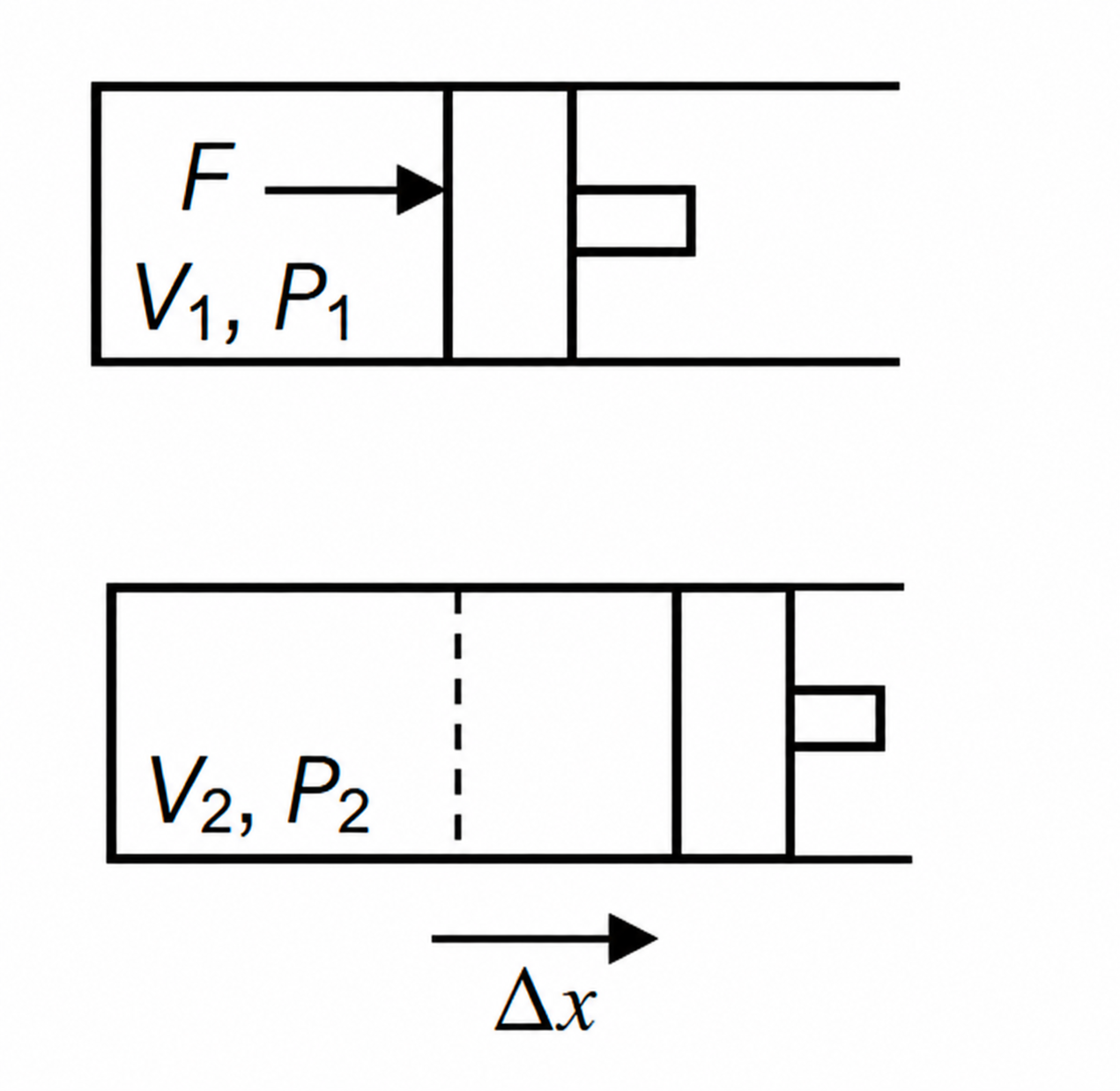 Consider a gas with volume $V$ and pressure $p$:
- The gas exerts pressure on the container walls, producing forces normal to the surface and directed outward.
- During expansion from to , the gas does work on the surroundings: , where is the pressure of the gas at volume .
- This relationship is apparent in the above example of gas expansion of a piston: Here, is the cross area of the piston. The derivation uses the following relationship: and .
Sign Convention
- Expansion (): → work done by the gas on the surroundings
- Compression (): → work done on the gas
Physical Meaning
The gas transfers energy to the surroundings by pushing the boundary (e.g. piston or container wall), causing a change in volume.
Work as Energy Transfer
Work done on a system transfers energy to the system. Negative work transfers energy from the system.
Examples
- Engine does work on a car → kinetic energy increases
- Friction does negative work → mechanical energy decreases
Conservative Force Case
For a conservative force within the system:
This means:
- positive work by the conservative force → potential energy decreases
- negative work → potential energy increases
If no other forces do work:
- a decrease in potential energy is transferred to kinetic energy
- an increase in potential energy comes from kinetic energy
1D Relation Between Force and Potential Energy
In one-dimensional motion, where the force depends only on position :
This shows that the force acts in the direction of decreasing potential energy.
Kinetic Energy Overview
Energy due to motion:
where:
- = mass
- = speed
Key facts:
- scalar quantity
- depends on speed squared
- always non-negative
See: Kinetic Energy and Work-Energy Theorem
Potential Energy Overview
Potential energy (in this chapter) refers to energy associated with position or configuration in a conservative force field, such as gravitational and elastic potential energy.
Gravitational Potential Energy (near Earth’s surface)
where:
- measured relative to chosen reference level (e.g., ground)
Elastic Potential Energy
For a Hooke’s law spring:
where:
- = spring constant
- = extension or compression, where is the equilibrium length of the spring
See: Potential Energy and Conservative Forces
Work-Energy Theorem Overview
Consider a chosen system.
This is the main source of confusion in energy questions.
Before writing an equation, first decide:
- what objects are included in the system
- which forces are external to that system
- whether potential energy is being included explicitly
Particle (Object-Only) System
If the system is a single object treated as a particle, the net work done by external forces on the system equals the change in its kinetic energy:
where:
- is the initial kinetic energy of the object (with initial speed )
- is the final kinetic energy of the object (with final speed )
Hence,
This is the most common form when you track one moving object and treat forces such as friction, tension, or weight as external forces doing work on it.
Extended System (Including Interactions)
If the system includes interacting bodies (e.g. object + Earth, object + spring), then:
- some forces become internal
- energy may be stored as potential energy within the system
In this case, the net work done by external forces on the system equals the change in the total mechanical energy of the system:
where:
- is the total kinetic energy of the system
- is the total potential energy of the system
- , where subscripts and denote “initial” and “final”
This form is often cleaner when the interaction itself stores energy, for example:
- object + Earth
- block + spring
- object + Earth + spring
Key Insight
The form of the energy equation depends on:
- what is included in the system
- which forces are treated as external
See: Kinetic Energy and Work-Energy Theorem
Conservation of Energy Overview
The total energy of an isolated system remains constant.
An isolated system is one in which there is no net energy transfer across the system boundary, i.e.:
- no work done by external forces
- no heat transfer
- no energy transfer by radiation
Energy may be transferred between different energy stores within the system:
- kinetic
- gravitational potential
- elastic potential
- thermal / internal
- electrical
Mechanical Energy
Mechanical energy of a system is:
If non-conservative forces are negligible:
If friction or drag acts:
Some mechanical energy is transferred to thermal/internal energy.
Conservative vs Non-Conservative Forces (Quick Clarification)
-
Conservative forces (e.g. gravitational force, elastic spring force):
- the work done between two points is independent of the path taken
- equivalently, the work done around any closed loop is zero
- transfer energy between kinetic and potential energy within the system
-
Non-conservative forces (e.g. friction, drag):
- the work done between two points depends on the path taken
- transfer energy from mechanical energy to other forms such as thermal/internal energy
Work Done by a Conservative Force and Potential Energy
For a conservative force internal to the chosen system (e.g. gravity in an object–Earth system, spring force in a mass–spring system):
where:
- is the work done by the conservative force within the system
- is the change in potential energy of the system
Energy Interpretation
The work done by the conservative force transfers energy between potential and kinetic forms within the system. If no other forces do work (i.e. no non-conservative forces):
so that:
- a decrease in potential energy corresponds to an increase in kinetic energy
- an increase in potential energy corresponds to a decrease in kinetic energy
Example
A freely falling object:
- gravitational potential energy decreases
- kinetic energy increases
since gravity is the only force doing work (air resistance neglected)
Interpretation
-
if the conservative force does positive work:
potential energy decreases
-
if the conservative force does negative work:
potential energy increases
Important Clarification
This relation applies when:
- the conservative force is treated as internal to the system, and
- its effect is accounted for via potential energy
If the same force is treated as external (e.g. analysing the object alone instead of object + Earth), then:
- potential energy is not included in the system
- the force contributes to external work instead
Key Idea
A conservative force transfers energy between kinetic and potential energy within the system:
- work done by the force does not create or destroy energy
- it changes how energy is stored
Mechanical Energy Conservation
If only conservative forces within a system act (i.e. non-conservative forces are negligible):
When Non-Conservative Forces Act
If friction or drag is present:
- mechanical energy is not conserved
- energy is transferred from mechanical energy to other forms
In short:
- if only conservative internal forces matter, mechanical energy is conserved
- if non-conservative forces matter, track the energy transferred out of mechanical stores
See: Energy Forms and Conservation
Power Overview
Power is rate of doing work or transferring energy.
Also:
Instantaneous mechanical power:
Magnitude form:
Unit:
See: Power and Efficiency
Efficiency Overview
As percentage:
Can use energy or power values consistently.
Real systems are always less than 100% efficient.
Short Worked Examples
Example 1: Work Done by Pulling Force
A force of pulls an object through in same direction.
Example 2: Negative Work by Friction
Friction force acts opposite motion over .
Example 3: Gain in Kinetic Energy
Net work done on object is .
So kinetic energy increases by .
Example 4: Power
A motor does of work in .
Formula Summary
Work
Kinetic Energy
Gravitational Potential Energy
Elastic Potential Energy
Work-Energy Theorem
Power
Efficiency
Exam Relevance
1. Forgetting Work Is Scalar
Do not write vector arrows on or energy terms.
2. Wrong Angle in
Angle must be between force and displacement.
3. Confusing Speed and Velocity
Use speed in:
4. Assuming Mechanical Energy Always Conserved
Not true if friction/drag present.
5. Mixing Energy and Power
- Energy in J
- Power in W
6. Wrong Height Reference
Only differences in gravitational potential energy matter.
Problem-Solving Strategy
Use:
Forces + Dynamics
Use this when asked about acceleration, force balance, or motion caused by specific forces.
See Dynamics.
Energy Methods
Use this when asked about speed, height, spring compression, or energy losses.
Power Methods
Use this when asked about rate of energy transfer, engine output, or efficiency.