Magnetic Force
Overview
A magnetic field can exert a force on:
- a current-carrying conductor
- a moving charged particle
- another current-carrying conductor through magnetic interaction
This topic studies how magnetic fields produce motion, turning effects, and particle deflection.
It builds directly from Magnetic Fields.
Core Ideas
Magnetic-force questions revolve around a few main ideas:
- magnetic force acts only when charge is moving
- the force is perpendicular to the magnetic field and to the current or velocity direction
- magnetic force can change direction of motion without changing speed
- conductor force and moving-charge force follow parallel formula structures
- current-carrying wires interact through the magnetic fields they create
Exam Relevance
Students are expected to:
- calculate force magnitude with the correct angle factor
- determine directions using Fleming’s left-hand rule and charge sign
- explain circular or helical motion in uniform magnetic fields
- distinguish magnetic force from electric force
- decide whether parallel currents attract or repel
Core Physical Idea
Magnetic force acts when charge is moving.
Hence:
- a stationary charge experiences no magnetic force
- a moving charge may experience force
- a conductor carrying current may experience force
Magnetic force is always perpendicular to both:
- magnetic field direction
- motion or current direction
Therefore magnetic force often changes direction of motion rather than speed.
Key Representations
Force on a Current-Carrying Conductor
A conductor of length , carrying current , in magnetic field experiences force:
where is a unit vector in the direction of conventional current flow.
Therefore, the magnitudes are related by:
where:
- = magnetic flux density
- = current
- = length of conductor in the magnetic field
- = angle between the current direction and magnetic field
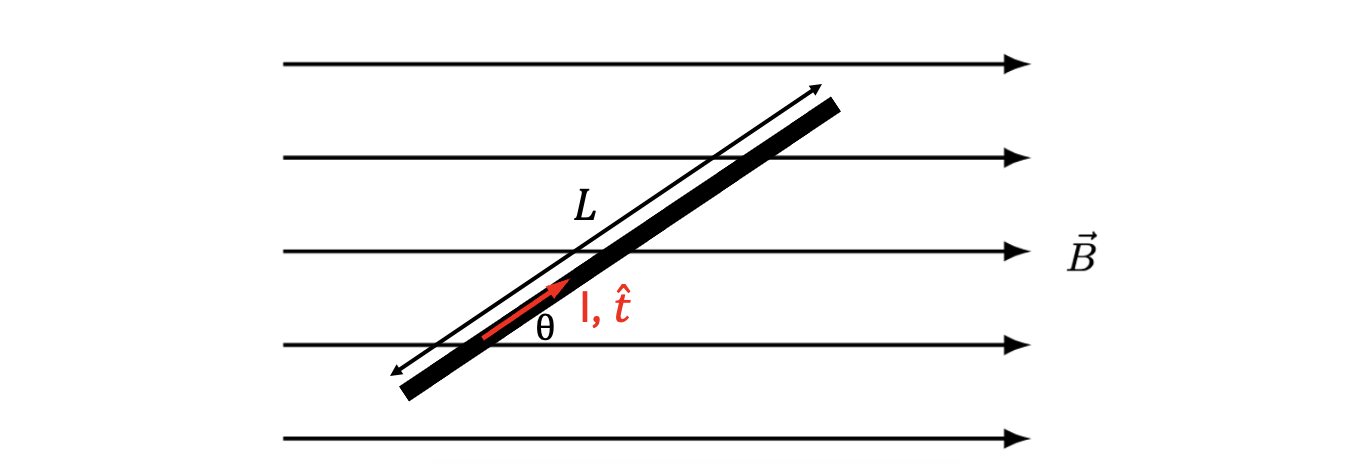 *Figure 1: The force on a current-carrying conductor is perpendicular to both the current and the magnetic field.*
Special Cases
Maximum Force
When:
Then:
Zero Force
When the conductor is parallel or anti-parallel to the field:
Then:
Direction of Force: by vector cross product
The direction of the force is determined by the vector cross product in
using the right-hand rule for cross products. The force is perpendicular to both the current direction and the magnetic field direction.
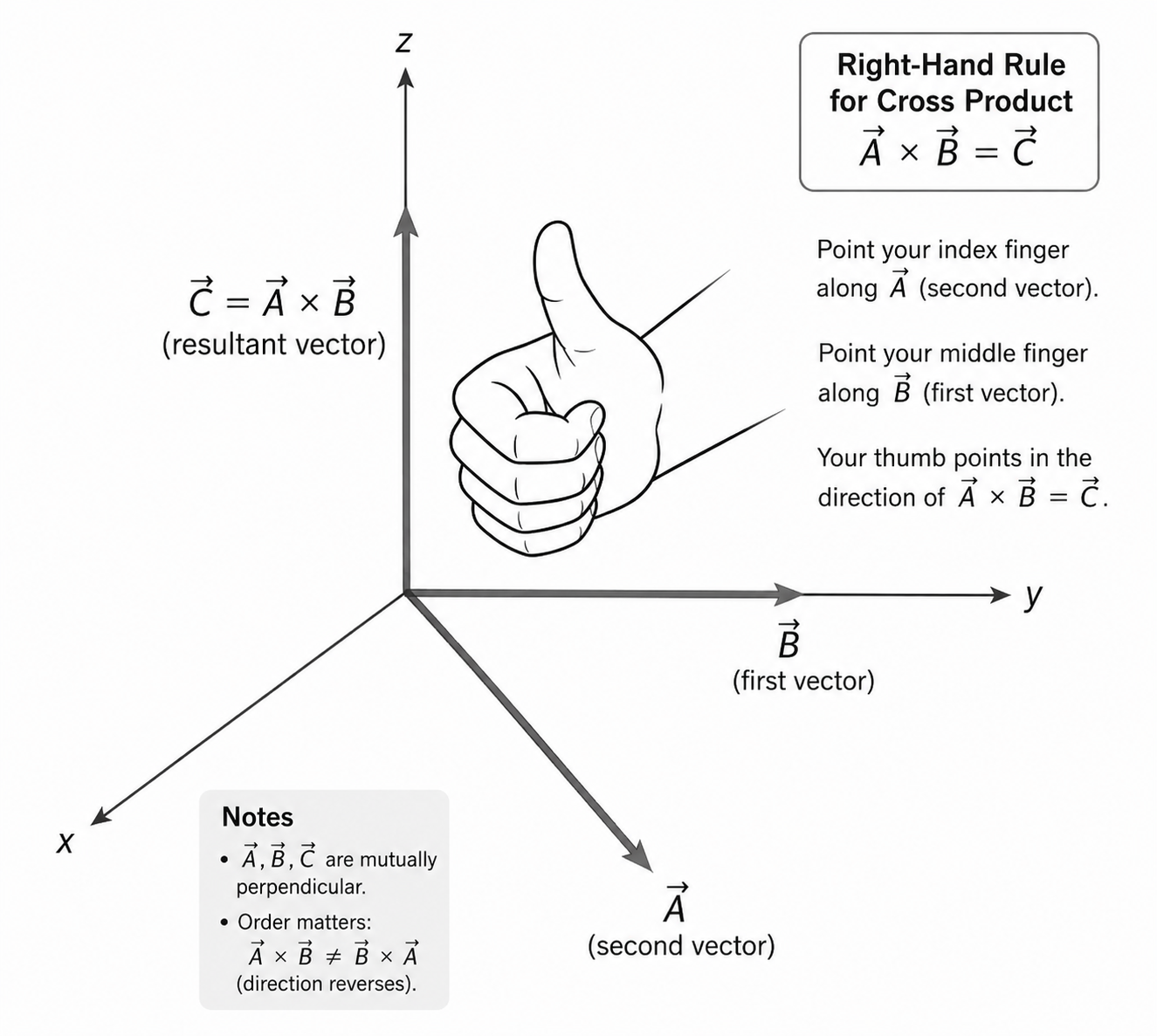 *Figure 2: Right-hand rule for determining the direction of a cross product. Curl the fingers of the right hand from $\vec{A}$ toward $\vec{B}$; the thumb then points in the direction of $\vec{A}\times\vec{B}$. The vectors $\vec{A}$, $\vec{B}$, and $\vec{A}\times\vec{B}$ are mutually perpendicular.*
### Direction of Force: Fleming's Left-Hand Rule
*Figure 2: Right-hand rule for determining the direction of a cross product. Curl the fingers of the right hand from $\vec{A}$ toward $\vec{B}$; the thumb then points in the direction of $\vec{A}\times\vec{B}$. The vectors $\vec{A}$, $\vec{B}$, and $\vec{A}\times\vec{B}$ are mutually perpendicular.*
### Direction of Force: Fleming's Left-Hand Rule
Fleming’s left-hand rule is a traditional convenient method for determining the direction of magnetic force when the current direction and magnetic field are perpendicular.
Use conventional current.
- first finger = magnetic field direction
- second finger = current direction
- thumb = force direction
This rule is consistent with the vector cross product relation:
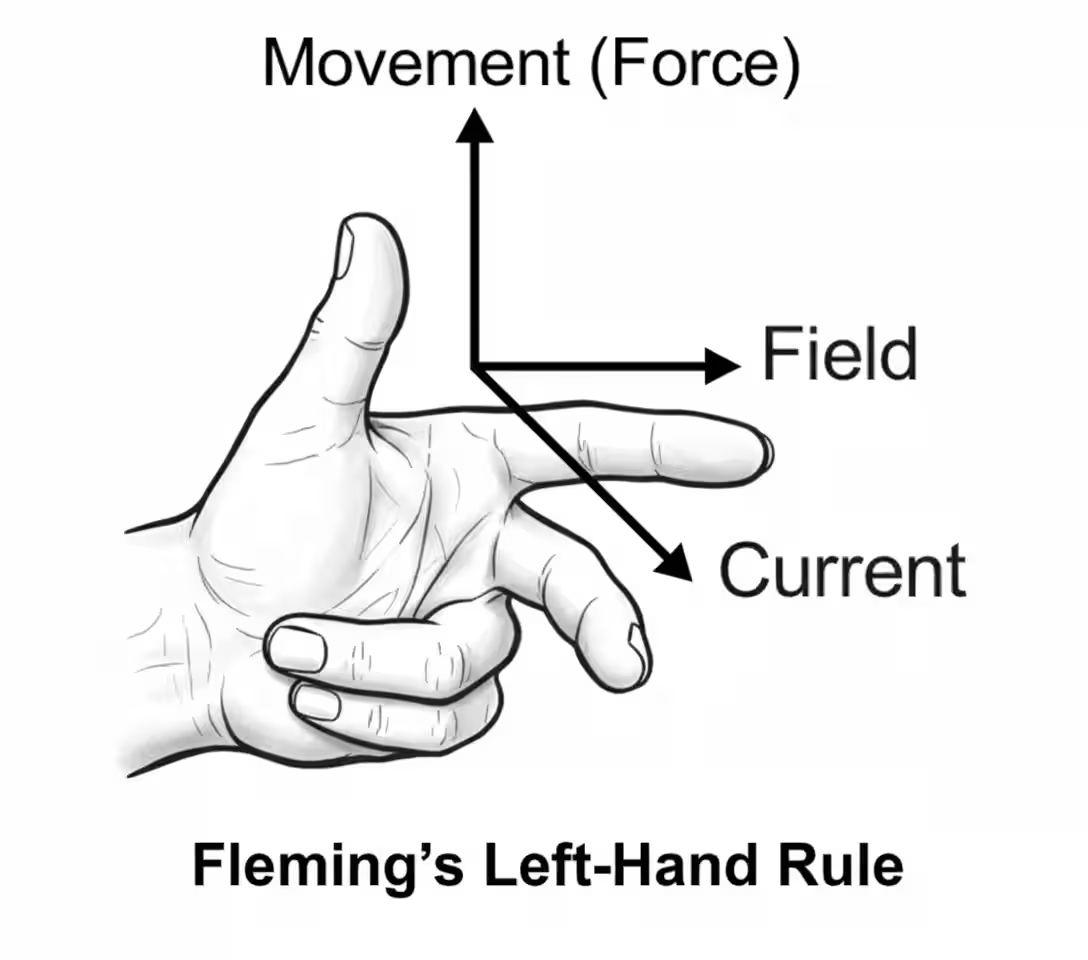 *Figure 3: Fleming's left-hand rule. The thumb, first finger, and second finger are mutually perpendicular, representing force, field, and conventional current respectively.*
Applications of Conductor Force
- electric motors
- loudspeakers
- moving-coil meters
- galvanometers
Definition of Tesla
From:
when the conductor is perpendicular to the magnetic field,
Hence, 1 tesla is the magnetic flux density of a magnetic field that produces a force of 1 N on a straight wire of length 1 m carrying a current of 1 A perpendicular to the field.
Force on a Moving Charge Overview
A charged particle moving with speed in a magnetic field experiences force:
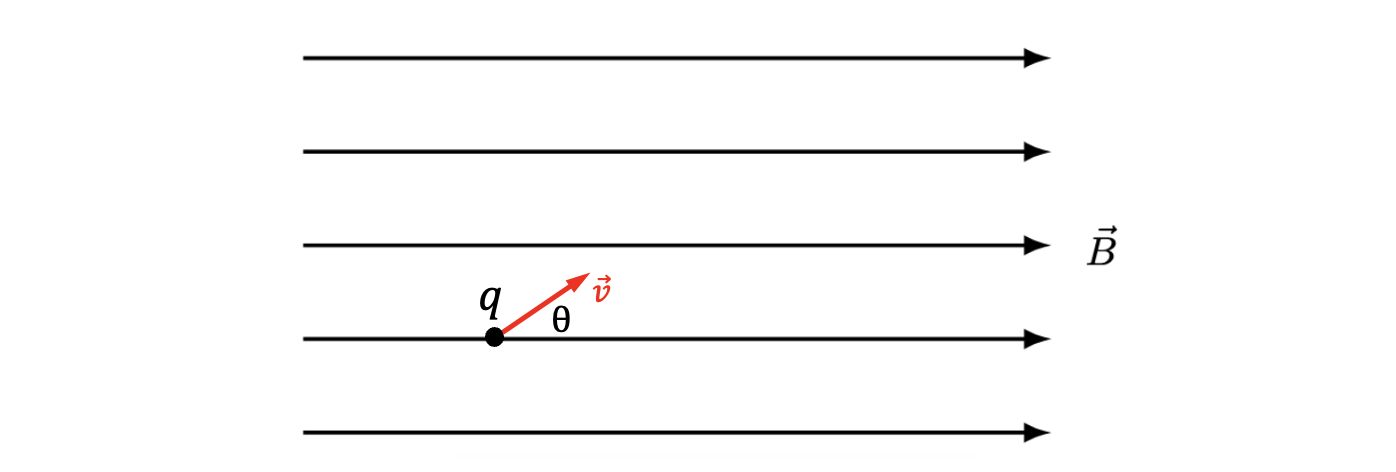 *Figure 4: A charge $q$ moving with velocity $\vec{v}$ at angle $\theta$ to a uniform magnetic field $\vec{B}$. The magnetic force on the charge is given by $\vec{F}=q\vec{v}\times \vec{B}$.*
The force is perpendicular to both and .
The magnitude of force is:
where:
- = charge magnitude
- = speed
- = angle between velocity and field
One may notice the similarity between the magnetic force acting on a straight current-carrying wire segment and that acting on a moving charge. This is not a coincidence — electric current itself arises from moving charges.
Detailed page: Charged Particles in Magnetic Fields
Direction of Particle Force
In general, the direction of the magnetic force on a moving charge is determined by the vector cross product:
using the right-hand rule for cross products.
For a positive charge moving perpendicular to the magnetic field, Fleming’s left-hand rule may alternatively be used as a traditional convenient method, with the current direction taken as the velocity direction.
For a negative charge:
- first determine the force direction for a positive charge
- then reverse the direction
Circular Motion in a Magnetic Field Overview
If a charged particle enters perpendicular (i.e., ) to a uniform magnetic field, then from
- the magnetic force is always perpendicular to the velocity
- the magnetic force acts as the centripetal force
- the particle follows a circular path
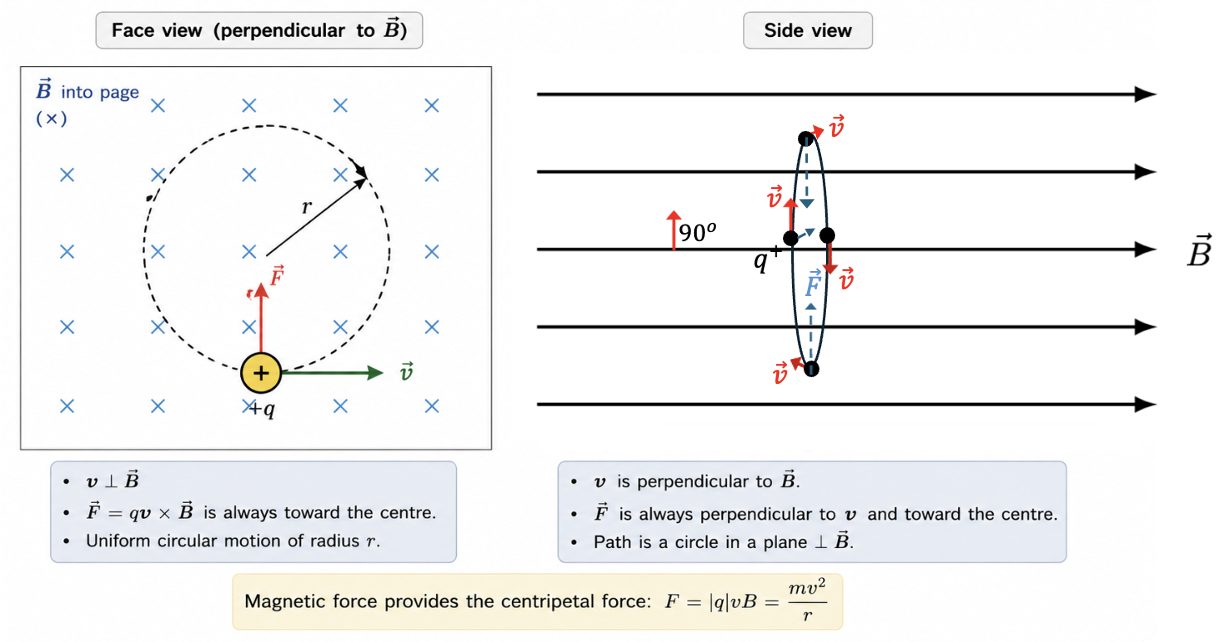 *Figure 5: Circular motion of a positively charged particle moving perpendicular to a uniform magnetic field. Left: face view showing the circular trajectory caused by the magnetic force acting as the centripetal force. Right: side view showing that the magnetic force is always perpendicular to the velocity and directed toward the centre of the circular path.
The magnitude of the magnetic force is:
*Figure 5: Circular motion of a positively charged particle moving perpendicular to a uniform magnetic field. Left: face view showing the circular trajectory caused by the magnetic force acting as the centripetal force. Right: side view showing that the magnetic force is always perpendicular to the velocity and directed toward the centre of the circular path.
The magnitude of the magnetic force is:
Using the centripetal force relation,
we obtain:
Hence,
Related topic: Circular Motion
Period of Circular Motion
So period is independent of speed.
Fast particles move in larger circles.
Helical Motion Overview
If velocity has:
- a component parallel to the field
- a component perpendicular to the field
Then:
- the perpendicular component causes circular motion
- the parallel component remains unchanged
Result: helical path.
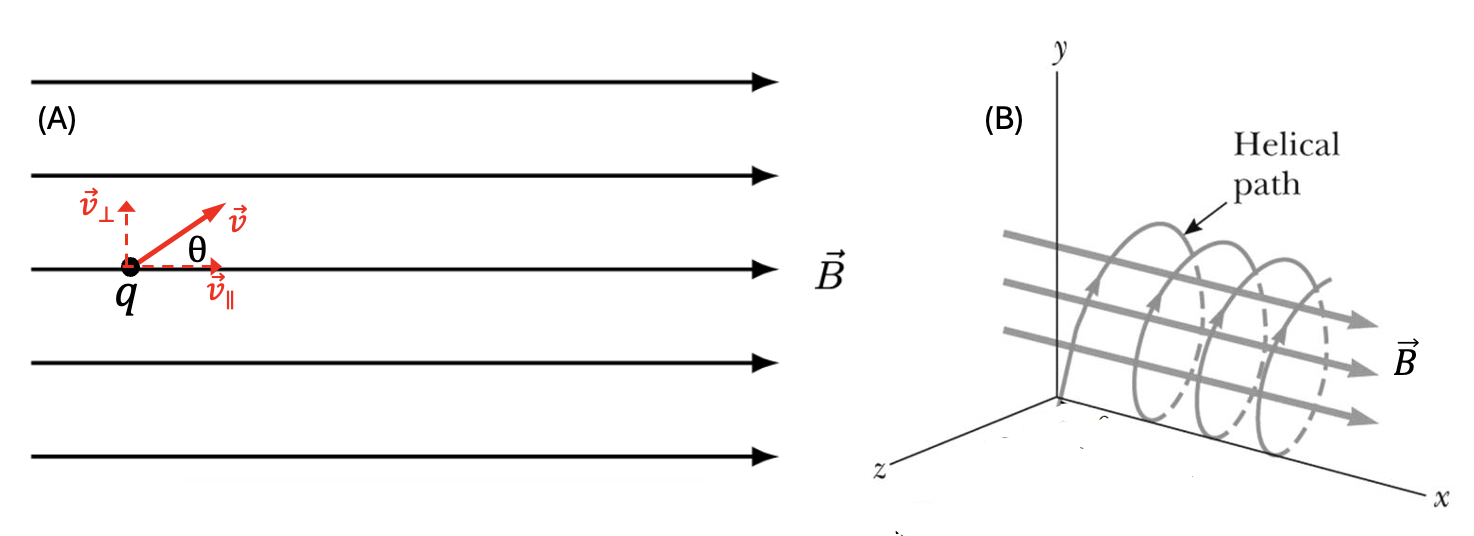 *Figure 6: Helical motion of a charged particle in a uniform magnetic field. (A) The velocity is resolved into a component perpendicular to the magnetic field, , and a component parallel to the field, . The perpendicular component experiences magnetic force and produces circular motion, while the parallel component experiences no magnetic force and therefore remains constant. (B) The combination of circular motion and constant forward motion produces a helical trajectory.
Crossed Fields / Velocity Selector Overview
When electric and magnetic forces act in opposite directions on a moving charge:
For undeflected motion:
So:
Only particles with this speed pass through undeflected.
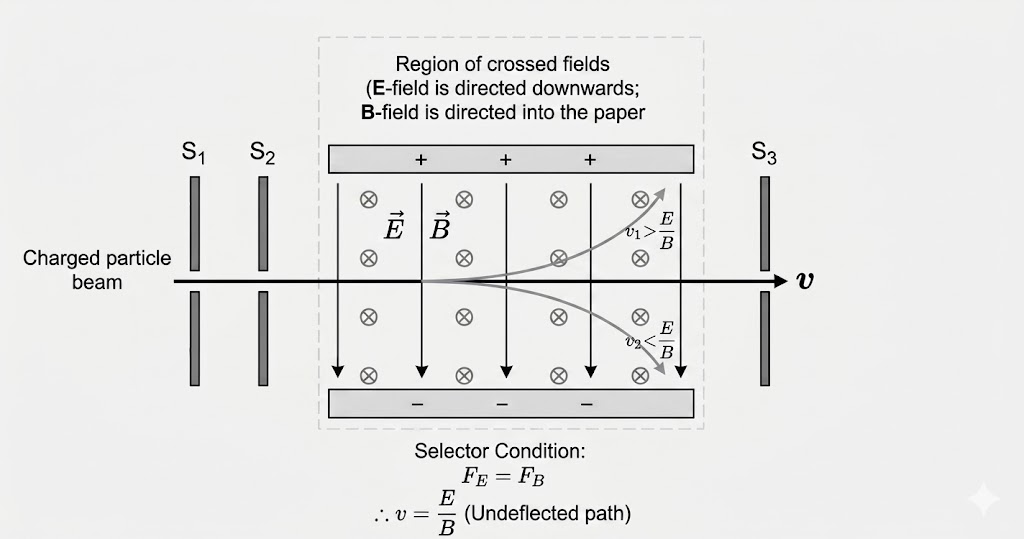 *Figure 7: Velocity selector using crossed electric and magnetic fields. Charged particles enter a region containing a downward electric field $\vec{E}$ and a magnetic field $\vec{B}$ directed into the page. Only particles with velocity
experience balanced electric and magnetic forces and pass through undeflected. Particles with larger or smaller velocities are deflected away. Linked topic: Electric Fields
Detailed treatment: Charged Particles in Magnetic Fields
Force Between Parallel Currents Overview
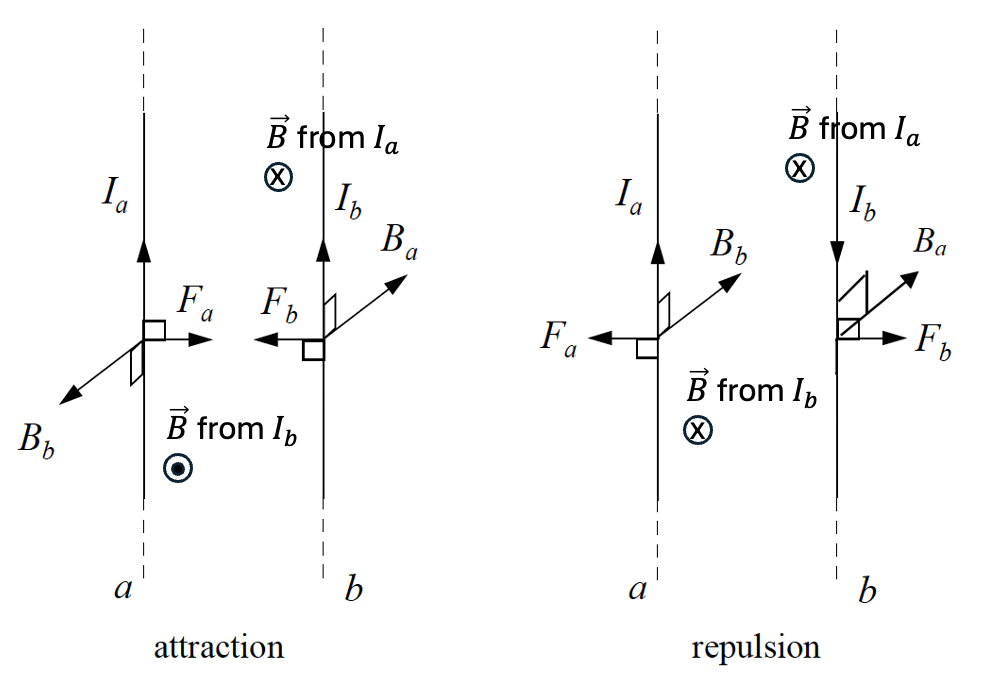 *Figure 8: Magnetic force between two parallel current-carrying wires. Left: currents in the same direction produce magnetic fields that cause the wires to attract. Right: currents in opposite directions produce magnetic fields that cause the wires to repel. The force on each wire arises from the magnetic field produced by the other wire. Two parallel current-carrying wires exert forces on each other.
- currents in the same direction attract
- currents in opposite directions repel
- the force direction may be determined using
or, equivalently, by Fleming’s left-hand rule.
Magnitude of the force between two parallel wires:
where:
- = permeability of free space
- , = currents in the two wires
- = length of wire considered
- = perpendicular separation between the wires
Detailed page: Force Between Parallel Currents
Short Worked Examples
Example 1: Force on Wire
A wire of length , current , and field is perpendicular to the field.
Example 2: Circular Radius
If doubles while , , and are unchanged:
Radius doubles.
Example 3: Parallel Wires
Two wires carrying current in the same direction attract each other.
Common Exam Traps Overview
Detailed page: Magnetic Force Common Exam Traps
Frequent mistakes:
- forgetting
- using the wrong hand rule
- getting electron direction wrong
- assuming magnetic force changes speed
- confusing attraction and repulsion of wires
- forgetting force is perpendicular
Summary Sheet
Force on Conductor
Force on Moving Charge
Circular Path
Period
Velocity Selector
Parallel Currents
Key Concepts to Remember
- magnetic force is perpendicular to the field
- magnetic force is perpendicular to motion or current
- magnetic force can bend a path without changing speed
- a stationary charge feels no magnetic force