Simple Harmonic Motion
Overview
Simple harmonic motion (SHM) is the most important ideal model of oscillatory motion. It describes motion in which the restoring effect causes acceleration toward equilibrium, with magnitude proportional to displacement from equilibrium.
Many physical systems approximate SHM for small displacements, including spring-mass systems, simple pendulums at small angles, vibrating molecules, tuning forks, and electrical oscillators.
Definition
A particle executes simple harmonic motion when its acceleration is:
- directly proportional to its displacement from equilibrium;
- always directed toward equilibrium.
Vector form:
In one-dimensional signed-component form, after choosing a positive direction:
where is the signed displacement component from equilibrium, is the signed acceleration component, and is the scalar angular frequency.
Why It Matters
SHM is fundamental because it produces sinusoidal motion and forms the basis of wave theory, resonance, and many advanced topics in physics. It also gives a clean way to connect force, motion, phase, and energy.
The central modelling test is whether the restoring acceleration or restoring force is proportional to displacement and directed back toward equilibrium.
Key Representations
Why SHM Occurs
SHM arises when the restoring force is proportional to displacement. If:
then by Newton’s second law:
so:
Comparing with gives:
This is why ideal springs naturally produce SHM.
In one-dimensional signed-component form, the same logic is often written more explicitly as:
Then:
so:
Comparing with:
shows that:
The negative sign gives the restoring direction. The proportionality to gives the harmonic relation.
Displacement, Velocity, and Acceleration
The displacement can be written as:
or:
where is amplitude and is phase constant.
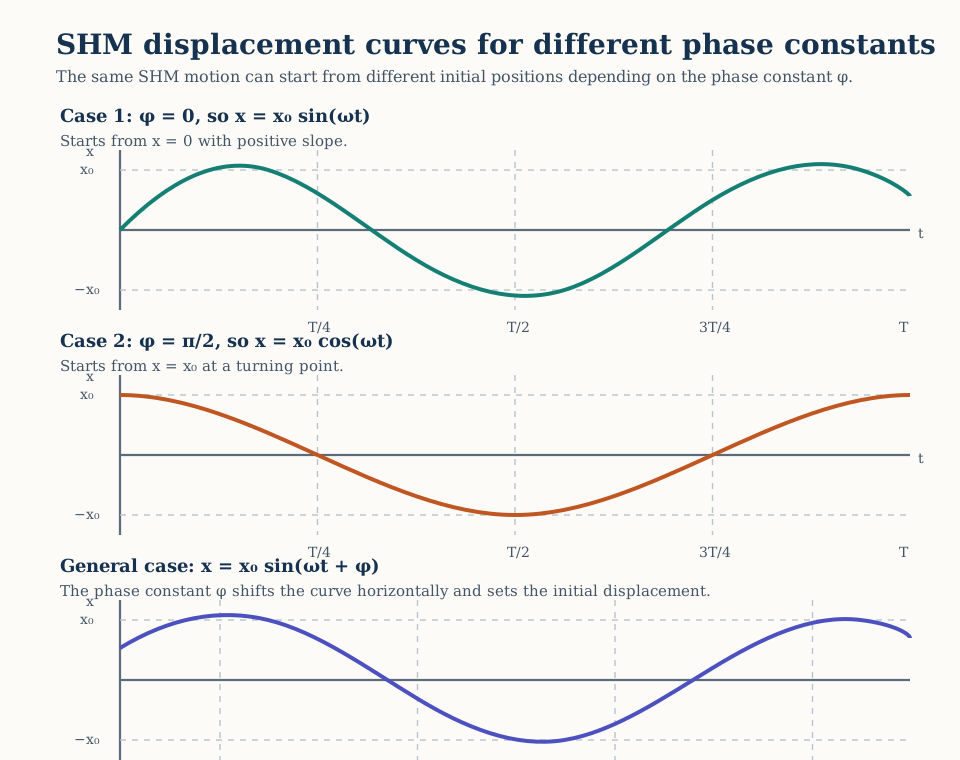 The cases $\phi=0$, $\phi=\pi/2$, and a general $\phi$ show how the same SHM shape can start from different positions on the displacement-time graph.
If:
then:
Here is the signed velocity component. The speed is .
Maximum speed:
Acceleration is:
Maximum acceleration magnitude:
This chain shows how the standard SHM equations are related mathematically:
- start with a sinusoidal displacement function
- differentiate once to get velocity
- differentiate again to get acceleration
- compare the final result with the original displacement
For
we obtain:
and:
Since , it follows that:
So the sinusoidal form and the SHM condition are two consistent descriptions of the same motion.
Time Quantities
Period:
Frequency:
Therefore:
Graphical Behaviour
The displacement-time graph is sinusoidal. The velocity-time graph is also sinusoidal and shifted by relative to displacement. The acceleration-time graph is sinusoidal and in antiphase with displacement.
The acceleration-displacement graph is a straight line:
with gradient:
This is a common test for SHM.
Phase Relationships
If:
then:
Velocity leads displacement by:
Acceleration is:
so acceleration is in antiphase with displacement. See Phase Difference.
Useful trigonometric identities behind these phase relationships are: , , and .1
Velocity-Displacement Relation
Eliminating time:
Hence:
This is useful when time is not given.
Energy in SHM
For ideal SHM, total mechanical energy remains constant:
Kinetic energy:
Potential energy:
Total energy:
Speed and kinetic energy are maximum at equilibrium. Acceleration magnitude and potential energy are maximum at turning points.
Physical Examples
For a spring-mass system:
For a simple pendulum at small angle:
See Pendulum Motion for the pendulum assumptions and derivation.
For a vertical spring-mass system, weight shifts the equilibrium position, but oscillation about that new equilibrium still obeys:
where is displacement from the equilibrium position, so the motion is still SHM with the same:
For a floating object with uniform cross-sectional area in a liquid of density , a small vertical displacement changes the upthrust by:
so the restoring force has the form:
which also implies SHM for small vertical oscillations about equilibrium.
Circular Motion Interpretation
SHM can be viewed as the projection of uniform circular motion onto one diameter. If a particle moves in a circle of radius with angular velocity vector , then and projected motion is:
Thus amplitude corresponds to radius, and angular frequency is the same as the circular motion.
Common Mistakes
- Forgetting the negative sign in .
- Confusing amplitude with instantaneous displacement.
- Assuming all oscillations are SHM.
- Forgetting velocity is zero at turning points.
- Using the pendulum SHM formula at large angles.
Summary
SHM is the special oscillation where acceleration is proportional to displacement and directed toward equilibrium. The defining equation links the motion, while the sinusoidal displacement, velocity, and acceleration graphs show the fixed phase relationships that appear repeatedly in exam questions.
Links
- Main topic: Oscillations and Simple Harmonic Motion
- Related concept: Phase Difference
- Related concept: Pendulum Motion
- Related concept: Damping and Resonance
- Related topic: Circular Motion
Footnotes
-
The first two identities explain why a phase shift of turns a sine form into the corresponding cosine form, and vice versa. The identity is what leads to the standard SHM ellipse in the - plane when and . ↩