Dynamics
Overview
Dynamics is the study of how forces cause changes in motion. While Kinematics describes motion using displacement, velocity and acceleration, Dynamics explains why that motion occurs.
This chapter develops the link between force and motion through Newton’s Laws of Motion, and extends to the ideas of momentum, impulse, and collisions.
Dynamics is foundational for later topics such as:
- Work, Energy and Power
- Circular Motion
- Oscillations
- Fields and interactions
Core Ideas
What Dynamics Studies
Typical questions in Dynamics ask:
- What is the acceleration of a body under given forces?
- What force is needed to produce a certain motion?
- What happens when two bodies interact?
- How do objects move when connected together?
- What happens during collisions or recoil?
To solve such questions, combine:
- force laws
- vector resolution
- Kinematics
- momentum methods
Newton’s Laws of Motion
Newton’s First Law
A body remains:
- at rest, or
- moving with constant velocity in a straight line
unless acted upon by a resultant external force.
Meaning
If:
then acceleration is zero:
The object may still be moving at constant velocity.
Inertia
Inertia is the tendency of a body to resist changes in motion.
- Larger mass → greater inertia
- Harder to start moving
- Harder to stop
- Harder to change direction
Newton’s Second Law
The resultant force acting on a body equals the rate of change of momentum:
where:
Constant Mass Case (H2 Standard Form)
If mass is constant:
Variable Mass Case (General Form)
If mass varies with time:
Applying product rule:
or:
Important Note (H2 Scope)
- Most H2 Physics problems assume constant mass, so:
is sufficient.
- The variable-mass form is relevant in systems such as:
- rockets
- leaking carts
- sand falling onto moving belts
but detailed treatment is typically beyond core H2 requirements.
Key meanings
- Force causes acceleration.
- Acceleration is in the same direction as resultant force.
- If resultant force increases, acceleration increases (for fixed mass).
Newton’s Third Law
If body A exerts a force on body B, then body B exerts a force on A that is:
- equal in magnitude
- opposite in direction
- of the same type
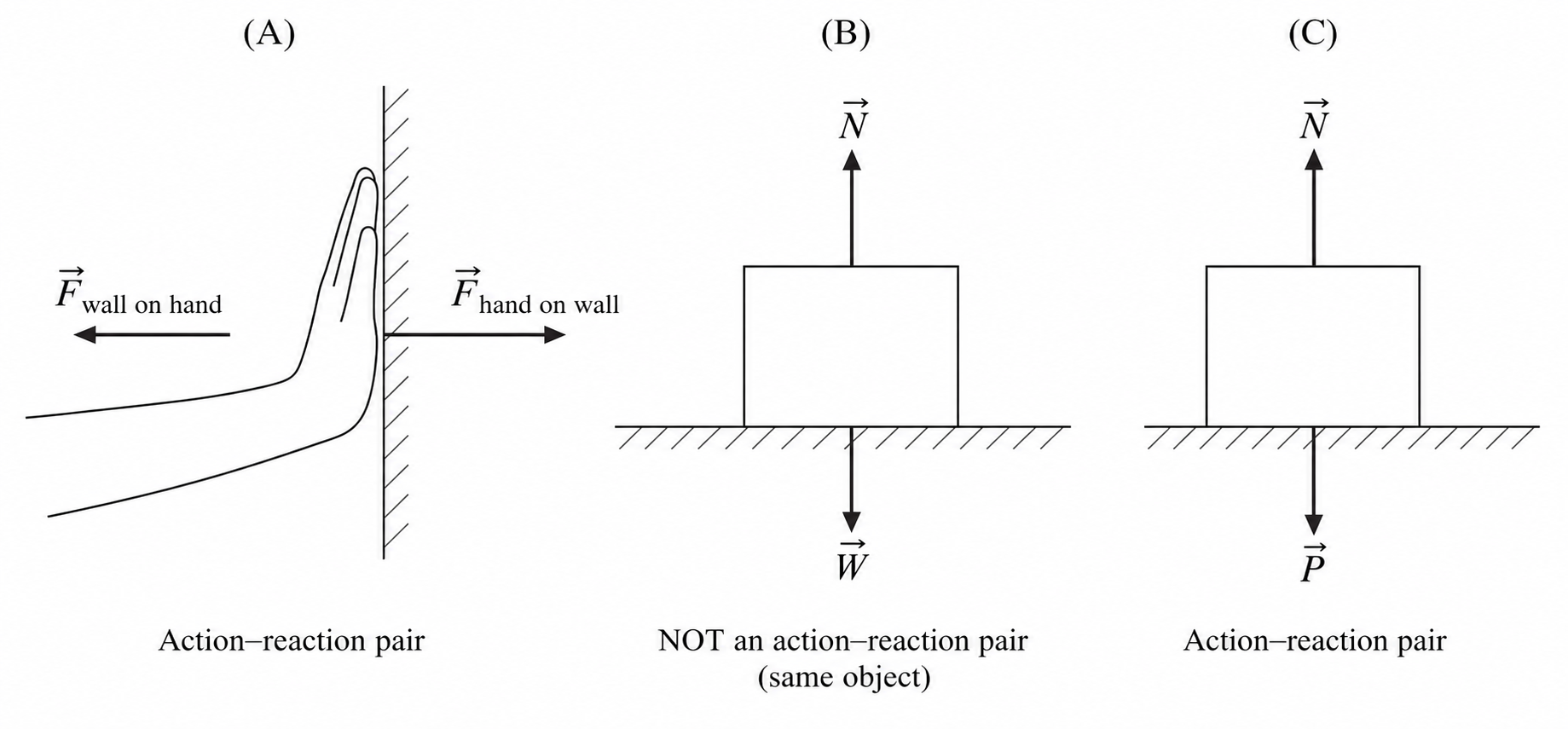
Figure: Newton’s third-law forces are equal and opposite, but they act on different bodies and therefore do not cancel on a single object.
Properties of Action–Reaction Pairs
They:
- act on different bodies
- are equal in magnitude
- are opposite in direction
- are of the same type of force (e.g. both normal forces, both gravitational forces)
- act along the same line of action
- occur simultaneously
Important Clarification
Action–reaction forces do not cancel, because they act on different bodies.
Example
- hand pushes wall
- wall pushes hand
These forces:
- are equal and opposite
- act on different objects
- form an action–reaction pair
For fuller statement and comparison of the three laws, see Newton’s Laws of Motion.
Mass, Inertia and Weight
Mass
Mass measures inertia.
- scalar quantity
- SI unit: kg
- independent of location
Weight
Weight is the gravitational force acting on a body:
- vector quantity
- acts vertically downward near the Earth’s surface
- unit: N
Sign Convention (Scalar Form)
If using a signed scalar approach and choosing upward as positive:
where:
Hence:
Key Idea
- Mass is constant.
- Weight depends on gravitational field strength.
Resultant Force and Acceleration
To analyse motion:
- Identify all external forces.
- Resolve forces into perpendicular directions.
- Apply:
Usually:
- horizontal direction
- vertical direction
treated separately.
Free-Body Diagrams Overview
A free-body diagram (FBD) isolates one object and shows all external forces acting on it.
Common forces:
- Weight
- Normal contact force
- Tension
- Friction
- Resistive force
- Applied force
- Upthrust (if relevant)
See full treatment: Free-Body Diagrams and Force Analysis
Force Resolution Overview
When a force acts at an angle, resolve it into perpendicular components. Each component is treated as a signed scalar along a chosen 1D axis.
Example:
For a force of magnitude making an angle above the positive horizontal direction:
Horizontal component:
Vertical component:
If the force points opposite to the positive direction of an axis, the corresponding component is negative.
Use Vectors carefully.
Standard Dynamics Applications
1. Horizontal Motion
Choose a positive direction (usually the direction of motion or acceleration).
Apply Newton’s Second Law along the horizontal direction:
Frictionless Case
If no resistive forces are present and taking the direction of the applied force as positive:
With Friction
If friction is present (acting opposite to motion), and taking the direction of motion as positive:
where:
- is the driving force
- is the frictional force
2. Vertical Motion / Lifts
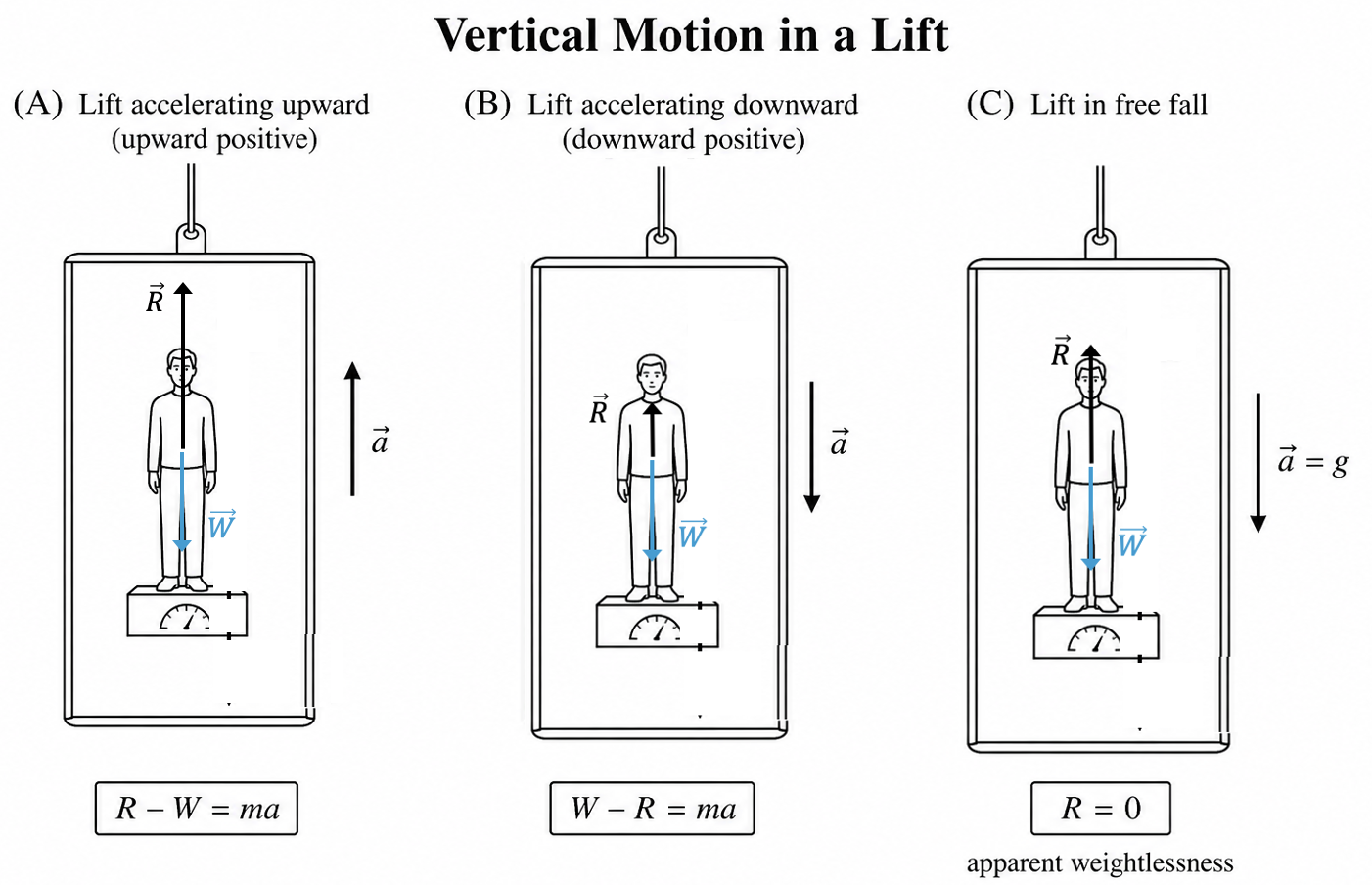
Figure: is the upward pushing force exerted by the scale on the person, while is the downward weight. The scale reading is the scalar , so it represents apparent weight and changes when the lift accelerates.
For vertical motion, first choose a positive direction.
Lift Accelerating Upward (upward positive)
Lift Accelerating Downward (downward positive)
Where:
- is the normal reaction (scale reading)
- is the weight
Free Fall Case
If the lift accelerates downward with :
The person is in free fall and experiences apparent weightlessness.
3. Connected Bodies
Bodies connected by a light, inextensible string share the same magnitude of acceleration along the direction of the string, provided the string remains taut.
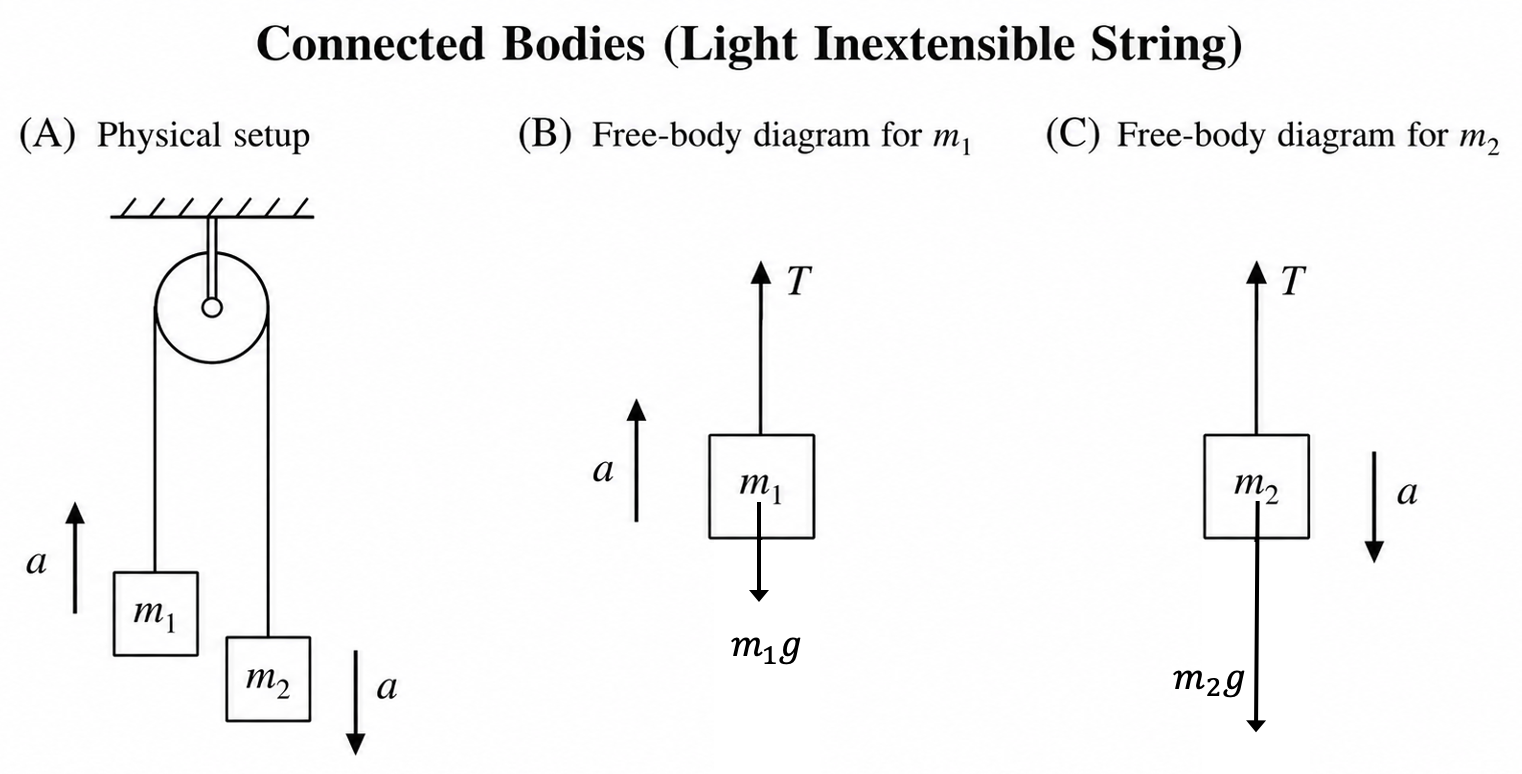
Figure: For two bodies connected by a light inextensible string over a smooth pulley, the tension has the same magnitude throughout the string and both bodies share the same acceleration magnitude.
This figure illustrates a system of two masses connected by a light, inextensible string passing over a smooth pulley.
(A) Physical Setup
- Two masses, and , are connected by a single string over a pulley.
- The string is light (mass negligible) and inextensible (length constant).
- The pulley is smooth, so tension is the same throughout the string.
If :
- accelerates downward
- accelerates upward
Both masses have the same magnitude of acceleration, denoted by .
(B) Free-Body Diagram for
For mass :
- Upward force: tension
- Downward force: weight
- Acceleration: upward with magnitude
Applying Newton’s Second Law (taking upward as positive):
(C) Free-Body Diagram for
For mass :
- Upward force: tension
- Downward force: weight
- Acceleration: downward with magnitude
Applying Newton’s Second Law (taking downward as positive):
Key Ideas
- The tension is the same in both diagrams (ideal string and pulley).
- The accelerations of and have the same magnitude but opposite directions.
- Each mass must be analysed using its own free-body diagram.
- Equations are solved simultaneously to find and .
These results rely on the ideal assumptions that the string is light and inextensible, and that the pulley is smooth and light.
Method
- draw a separate free-body diagram for each body
- apply:
to each body
- solve the resulting simultaneous equations
Important Note
only holds when there are no additional forces with components perpendicular to the plane (e.g. no pushing force or tension acting into or away from the plane).
Inclined Plane (Force Conditions)
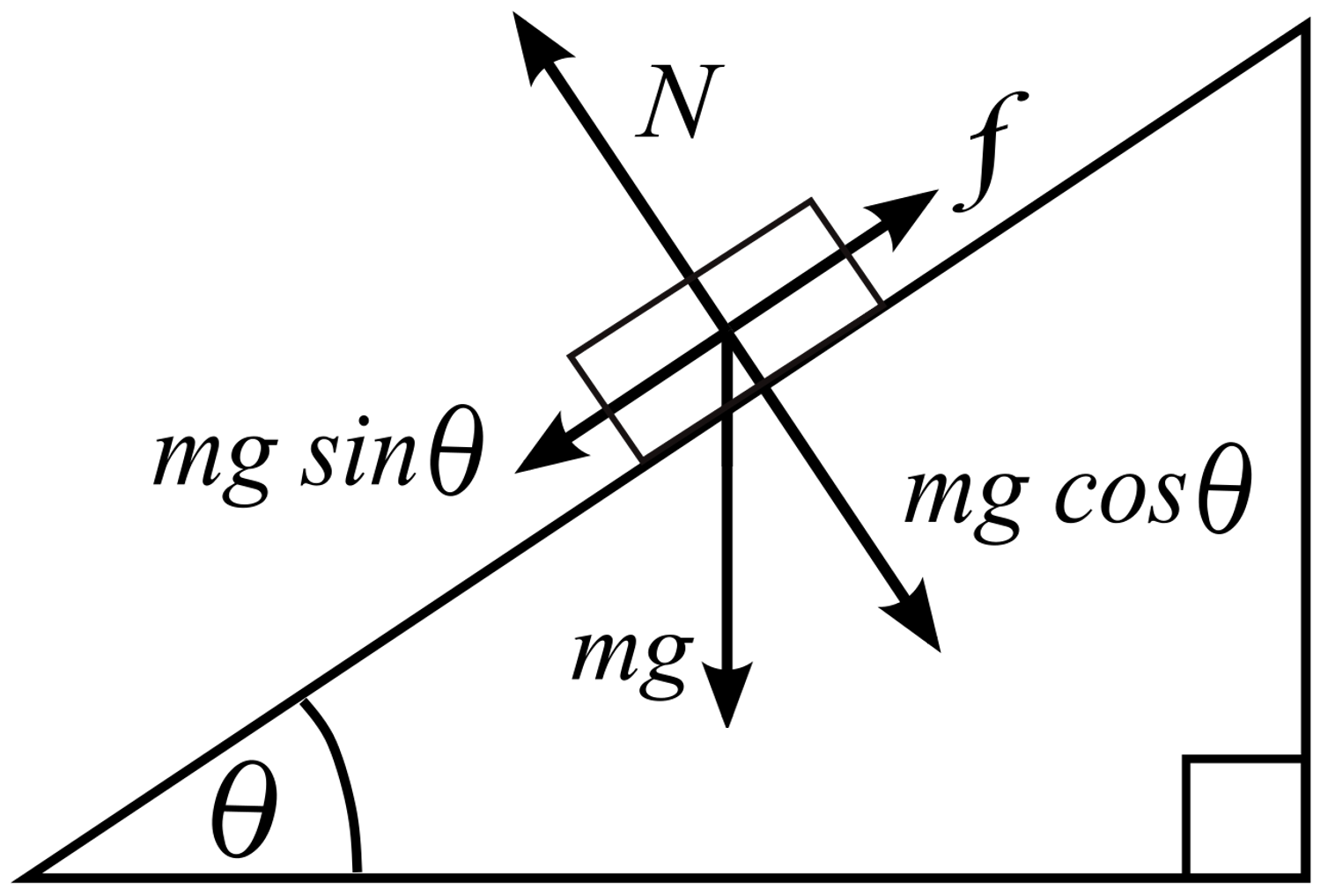
Figure: On an inclined plane, the weight is resolved into components parallel and perpendicular to the slope, while the normal reaction acts perpendicular to the surface and friction acts along the surface opposing motion or impending motion.
Resolve the weight :
- Parallel to slope (down the plane):
- Perpendicular to slope (into the plane):
Normal Reaction
If no other forces act perpendicular to the surface:
Friction (Static or Constant Velocity)
If the object is:
- at rest, or
- moving with constant velocity (i.e. ),
then along the slope:
Important Notes
- The direction of friction is opposite to motion or impending motion.
- The relation only holds when:
- acceleration is zero, and
- no other forces act along the slope.
General Case (taking downslope as positive)
where is the magnitude of the frictional force acting upslope. More generally, you may treat friction as a signed scalar if you define the positive direction first and keep the sign convention consistent.
For more worked applications involving lifts, connected bodies, and inclined planes, see Newtonian Dynamics Applications.
Momentum Overview
Momentum:
- vector quantity
- same direction as velocity
Large momentum may arise from:
- large mass
- high speed
- both
See: Momentum and Impulse
Impulse Overview
Impulse is the change in momentum:
For constant force:
More generally:
For constant force, this reduces to:
1D Scalar Form
In 1D, with a chosen positive direction and signed scalar convention:
Impulse is equal to the area under the force–time graph.
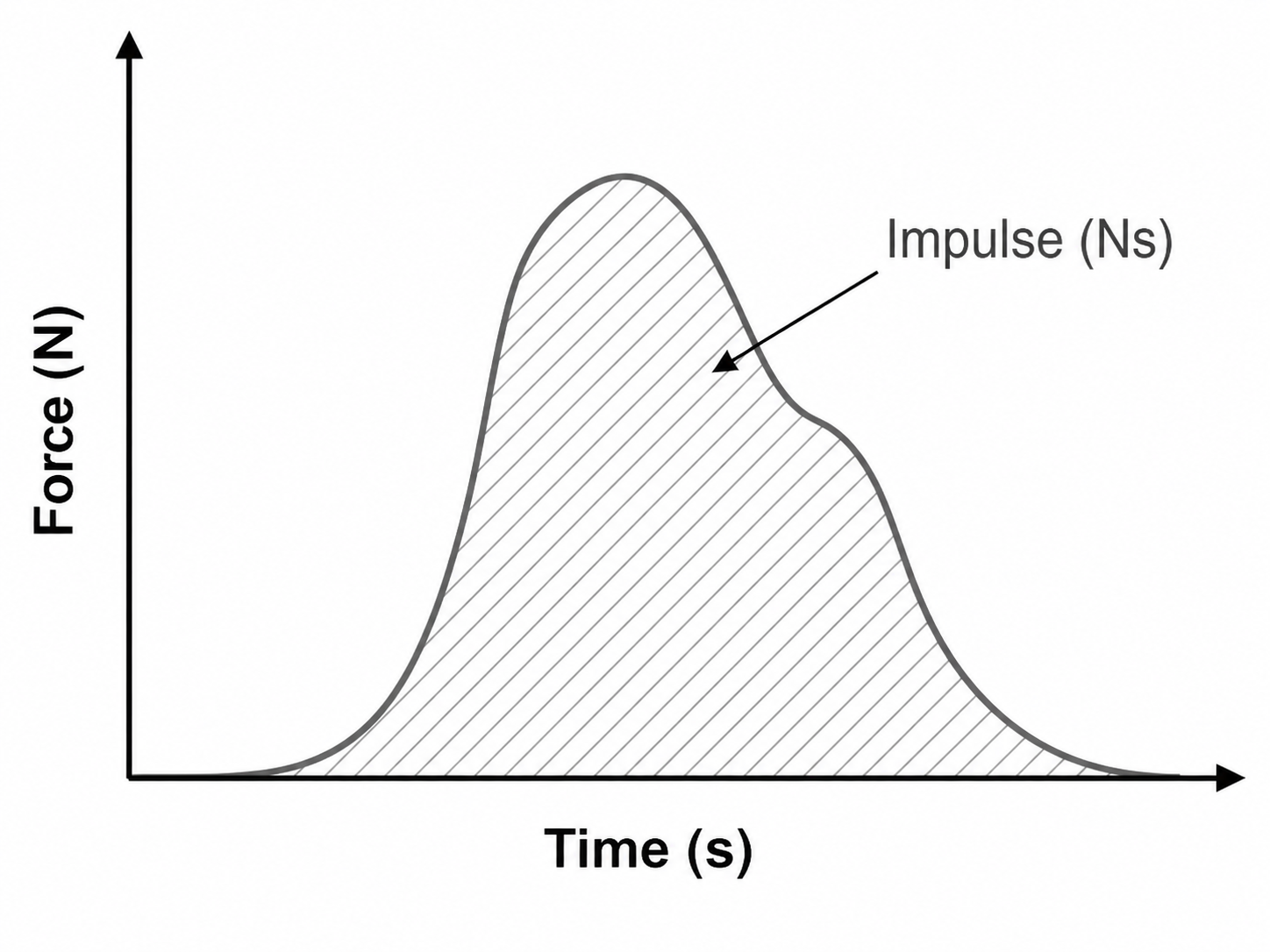
Figure: The impulse delivered over a time interval equals the signed area under the force-time graph and is equal to the change in momentum.
Key Idea
For a given change in momentum:
- increasing the collision time reduces the average force
Applications
- airbags
- crumple zones
- bending knees when landing
See: Momentum and Impulse
Conservation of Momentum Overview
For an isolated system with no resultant external force:
or equivalently,
Two-Body System in general
1D Scalar Form
For motion in one dimension, using a signed scalar convention:
Applications
- recoil
- explosions
- collisions
See: Momentum Conservation and Collisions
Collisions Overview
Elastic Collision
In an elastic collision, both momentum and kinetic energy are conserved.
Conservation Laws
- momentum:
- kinetic energy:
1D Collision Result
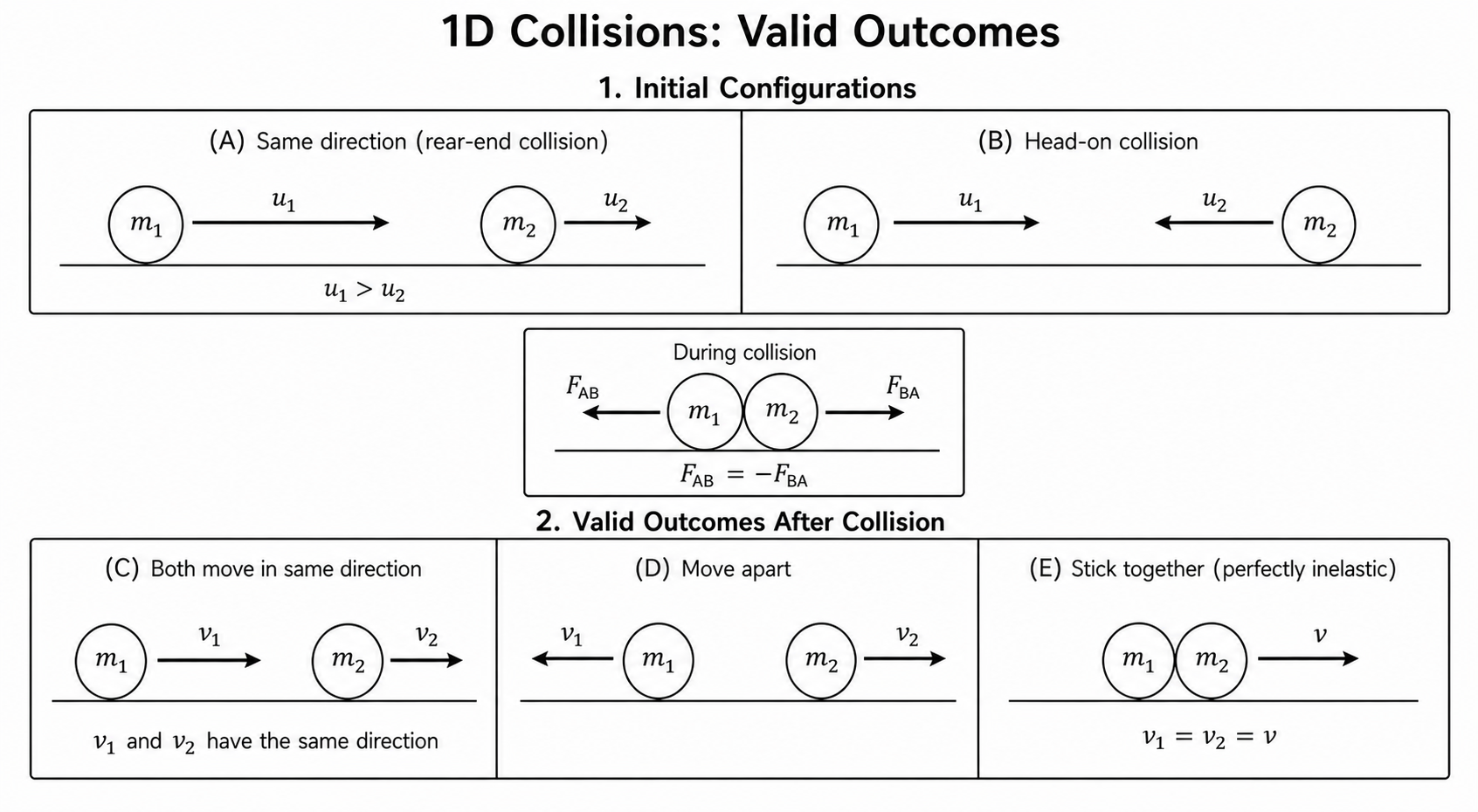
Figure: In a one-dimensional elastic collision, the relative speed of approach equals the relative speed of separation when velocities are treated as signed scalars along the same line.
For motion in one dimension, combining conservation of momentum and kinetic energy gives the signed-scalar relation:
Interpretation
- relative speed of approach = relative speed of separation
Inelastic Collision
In an inelastic collision, momentum is conserved but kinetic energy is not.
Conservation of Momentum
Energy Change
- kinetic energy decreases
- the loss is converted into:
- heat
- sound
- deformation
Perfectly Inelastic Collision
In a perfectly inelastic collision, the bodies stick together after impact and move with a common velocity.
Common Final Velocity
Conservation of Momentum
Short Worked Examples
Example 1: Horizontal Force
A 4.0 kg block experiences a resultant force of 10 N.
Example 2: Momentum
A 2.0 kg trolley moves at 3.0 m s.
Example 3: Impulse
A force of 20 N acts for 0.50 s.
Exam Relevance
Dynamics questions test whether you can:
- identify forces correctly
- choose a sensible system
- apply Newton’s laws consistently
- use momentum methods when force-based methods are awkward
Formula Summary
Newtonian Motion
Weight
Momentum
Impulse
Conservation of Momentum
Elastic Collision (1D)
Common Exam Pitfalls
1. Forgetting vector directions
Momentum, force, acceleration are vectors.
2. Mixing action-reaction pair with balanced forces
Balanced forces act on same body.
Third-law pair act on different bodies.
3. Assuming normal force always equals weight
Only true in special cases.
4. Using momentum conservation when external force exists
Must analyse system carefully.
5. Wrong sign convention
Choose positive direction clearly.
6. Confusing mass and weight
Mass in kg, weight in N.
Revision Strategy
Master this order:
- Newton’s laws
- Free-body diagrams
- Connected-body systems
- Inclined planes
- Momentum
- Impulse
- Collisions
Learning Path
- Newton’s Laws of Motion
- Free-Body Diagrams and Force Analysis
- Newtonian Dynamics Applications
- Momentum and Impulse
- Momentum Conservation and Collisions
- Dynamics Methods and Non-Constant Forces (optional enrichment)
- Forces
- Kinematics
- Vectors
- Work, Energy and Power
- Circular Motion
Final Takeaway
Dynamics turns motion description into physical explanation. If you can:
- draw accurate free-body diagrams
- apply consistently
- choose between force, impulse, and momentum methods sensibly
- handle collisions with the correct conservation laws
you will be strong in one of the most important H2 Physics chapters.
Links
- Prerequisite: kinematics
- Prerequisite: forces
- Prerequisite: vectors
- Related: newtons laws of motion
- Related: force diagrams and resolution
- Related: newtonian dynamics applications
- Related: momentum and impulse
- Related: momentum conservation and collisions
- Related: dynamics methods and non constant forces
- Related: work energy and power
- Related: circular motion
- Related: centre of gravity and stability
- Misconception: newtons laws distinction
- Misconception: force identification errors
- Misconception: vector direction consistency
- Misconception: momentum conservation system
- Misconception: inelastic ke conservation
- Misconception: elastic relative speed application
- Misconception: apparent weightlessness gravity
- Misconception: force resolution angles
- Misconception: force time graph area
- Misconception: scalars vs vectors
Provenance
- source file: 1_PDFsam_04_Dynamics.pdf
- generated by:
bridging_tools/ingest_JC_phy_wiki.py - manifest entry:
inbox/lecture_notes/1_PDFsam_04_Dynamics.pdf - source hash:
5a33c17a1944110085919fe2b68b7f99ed9821e8e0dfc83e670c29f36c5be2ff