Projectile Motion
Overview
Projectile motion is two-dimensional motion under gravity where an object is launched into the air and then moves freely after release.
This topic builds on:
The key method is to split motion into:
- horizontal motion
- vertical motion
and solve them separately using a common time variable.
Core Ideas
What is Projectile Motion?
A projectile is an object that, after launch, moves under the influence of gravity alone (ideal model).
Examples:
- thrown ball
- kicked football
- launched stone
- package dropped from aircraft
Its path is usually parabolic when air resistance is neglected.
Assumptions
Unless stated otherwise, use the standard H2 model:
- air resistance is negligible
- acceleration due to gravity is constant
- gravity acts vertically downward
- Earth curvature is ignored
- projectile treated as a particle
Hence:
if upward is chosen as positive.
Resolving the Initial Velocity
If launch speed is at angle above horizontal:
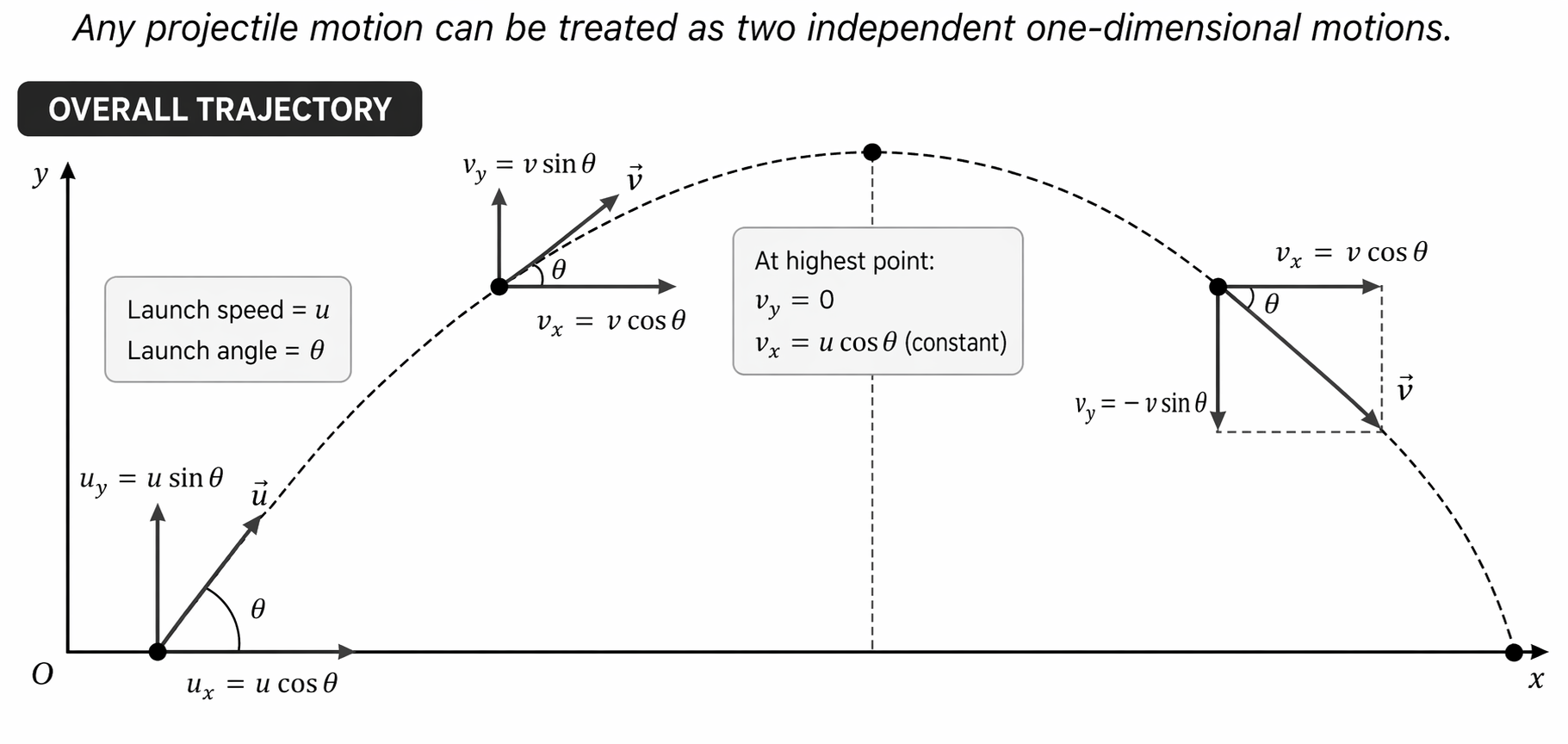
Figure: Resolve the launch velocity into horizontal and vertical components. The horizontal component stays constant, while the vertical component changes under gravity.
These become the initial velocities in each direction.
Horizontal and Vertical Motion
Horizontal Motion
Since no horizontal acceleration:
So:
Horizontal velocity remains constant.
Vertical Motion
Take upward as positive:
where is the magnitude of gravitational acceleration.
Using constant-acceleration equations:
where is the signed vertical displacement.
Vertical velocity changes uniformly because the acceleration is constant.
Same-Time Link
The most important connection:
Horizontal and vertical motions share the same time .
This is the bridge that allows two separate component equations to be combined.
Key Standard Results
These formulas apply to the common case:
- launch and landing at same vertical level
- air resistance neglected
Time of Flight (Level Ground)
For a projectile that lands at the same vertical level as launch:
Using:
Solving gives:
The non-zero solution is the time of flight.
Maximum Height
At the highest point:
Using:
and
we get:
Therefore:
where is the maximum height above the launch point.
Horizontal Range (Level Ground)
The horizontal range is:
For a projectile that lands at the same vertical level as launch:
So:
This result is valid only when launch and landing heights are the same.
Maximum Range
For level launch and landing, with fixed launch speed and negligible air resistance:
Since:
maximum range occurs when:
so:
Highest Point
At the top of the trajectory:
but:
So the projectile is not in equilibrium.
Also:
still remains non-zero (unless launched vertically).
Level-Ground Projectile Reasoning
For launch and landing at same height:
- ascent time = descent time
- path is symmetric (ideal model)
- speed at landing equals speed at launch
- launch angle = landing angle (same magnitude)
Non-Level Launch / Landing (Qualitative)
If landing height differs from launch height:
- motion is no longer symmetric
- time up ≠ time down
- standard formulas for , , may need modification
- safest method: solve horizontal and vertical equations directly
Worked Examples
Example 1: Component Resolution
A ball is launched at at above the horizontal.
Resolving into components:
Taking upward as positive:
- initial horizontal velocity is
- initial vertical velocity is upward
Example 2: Time of Flight
A projectile is launched at at above the horizontal.
For motion where launch and landing are at the same vertical level:
Substituting:
Example 3: Range
Using the same projectile (, ), and assuming launch and landing occur at the same vertical level:
Use vertical motion to find time first, then horizontal motion:
Example 4: Horizontal Launch from Table
A ball leaves a table horizontally at from a height of .
Initial vertical velocity:
Take upward as positive:
Using vertical motion:
Then horizontal motion:
Common Exam Pitfalls
- mixing horizontal and vertical quantities in one equation
- forgetting to resolve initial velocity
- using different times for x and y motions
- assuming acceleration is zero at highest point
- using range formula when landing level differs
- using instead of horizontally
- wrong sign for vertical acceleration
- forgetting horizontal velocity is constant
Exam Relevance
Projectile-motion questions test component resolution, sign convention, and the correct use of a common time variable across horizontal and vertical motion.