Conservation Laws in Physics
Overview
Conservation Laws in Physics is a synthesis page. It brings together conservation ideas used across H2 Physics, especially mechanics and nuclear physics.
Conservation laws are useful because they restrict what can happen even when the detailed mechanism is complicated.
They are used in:
- collisions and recoil
- energy-transfer problems
- current junctions
- nuclear decay
- fission and fusion
- particle-level beta-decay equations
Core Ideas
- conservation laws apply to a clearly chosen system
- total energy is conserved when all forms are counted
- total momentum is conserved when the resultant external force or external impulse is zero or negligible
- total charge is conserved in electric, nuclear, and particle processes
- nuclear equations must conserve nucleon number
- nuclear equations must balance the lower numbers; for nuclei this is proton number , and across the full equation it is total charge accounting
- in nuclear processes, mass-energy is conserved; rest mass may change while kinetic energy or radiation energy increases
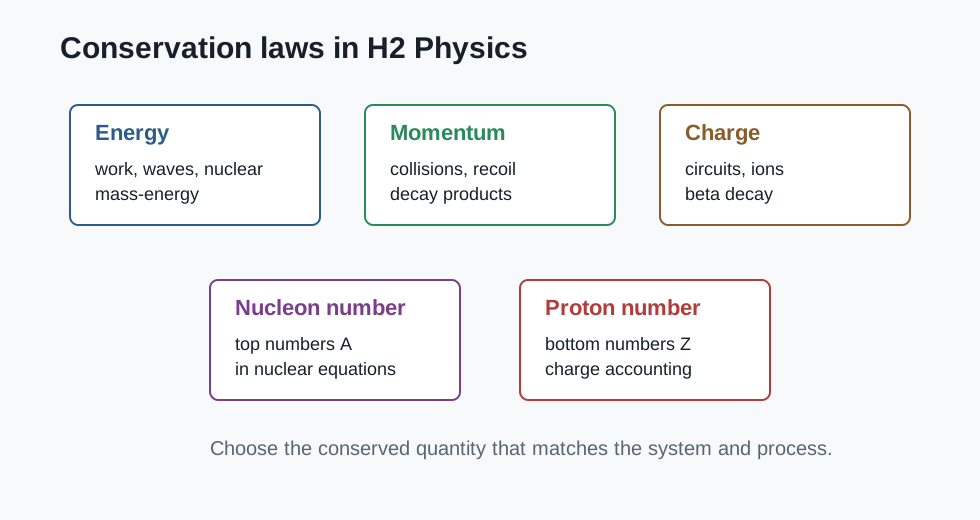
Conservation laws constrain what can happen across mechanics, circuits, and nuclear processes.
Main Conservation Laws in H2 Physics
Conservation of Energy
Energy cannot be created or destroyed. It can be transferred or transformed.
Examples:
- gravitational potential energy to kinetic energy
- electrical energy to thermal or light energy
- nuclear rest-energy difference to kinetic energy or radiation
For the broader treatment of energy forms and transfers, see Energy Forms and Conservation and Work, Energy and Power.
Conservation of Linear Momentum
In a system with no resultant external force, or negligible external impulse during the interaction:
where:
Momentum is a vector, so direction and sign convention matter.
It is used in:
- collisions
- explosions
- recoil
- nuclear decay products moving apart
For deeper collision treatment, see Momentum Conservation and Collisions.
Conservation of Charge
Total electric charge remains constant.
This appears in:
- electric circuits
- ionisation
- particle decay
- nuclear equations
In nuclear notation, the lower number tracks proton number and charge contribution.
Conservation of Nucleon Number
In H2 nuclear equations, total nucleon number is conserved:
The top numbers in a nuclear equation must balance.
Conservation of Proton Number and Charge Number
For nuclei, is the proton number. Across a complete nuclear equation, the lower numbers must balance because total charge is conserved:
For emitted beta particles, the lower number is a charge number rather than a proton count.
So in H2 nuclear equations, balancing the lower numbers is a practical way of checking charge conservation.
Conservation of Mass-Energy
In classical mechanics, mass is often treated as conserved.
In nuclear physics, that wording is too weak. The more precise statement is:
- rest mass may decrease or increase
- energy may appear as kinetic energy or radiation
- total mass-energy remains conserved
Einstein’s relation links mass and energy:
For a nuclear process where product rest mass is smaller than reactant rest mass:
where:
The same idea can be expressed using binding energy:
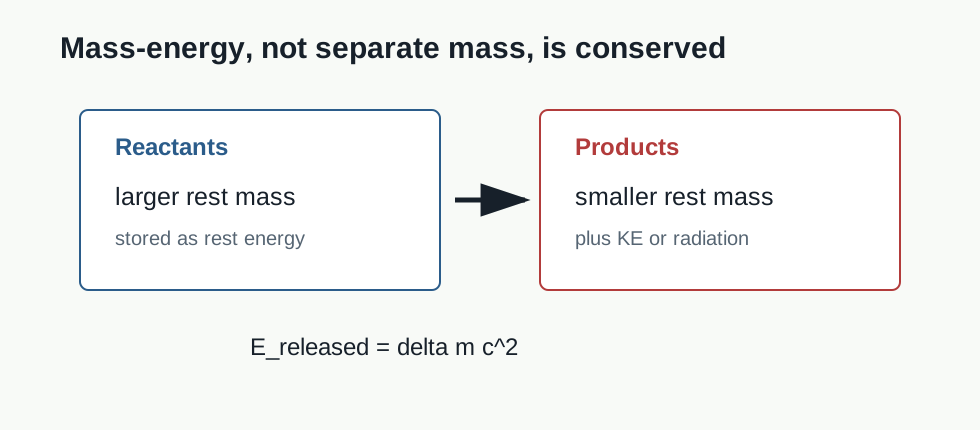
In nuclear processes, mass-energy is conserved even when rest mass changes.
Applications in Mechanics
Collisions
For isolated systems:
Types of Collision
Elastic Collision
- momentum conserved
- kinetic energy conserved
Inelastic Collision
- momentum conserved
- kinetic energy not conserved
Explosions and Recoil
Initial momentum may be zero.
After separation:
- total momentum is still zero
Example:
Gun recoil:
- bullet forward momentum
- gun backward momentum
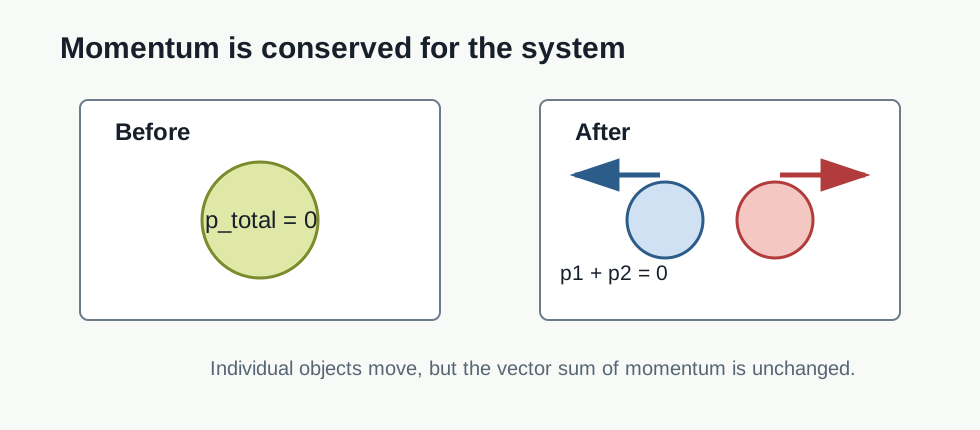
Momentum conservation applies to the whole system, so final momenta can cancel even when each object moves.
Applications in Nuclear Physics
Conservation laws determine valid nuclear equations.
Example: Alpha Decay
Check:
- nucleon number conserved
- proton number conserved
- energy conserved
- momentum conserved
Example: Beta Decay
The antineutrino helps account qualitatively for energy and momentum.
A full lepton-number treatment is beyond the H2 scope of this wiki.
Applications in Circuits
Charge Conservation at a Junction
Charge conservation gives Kirchhoff’s first law:
Current entering a junction equals current leaving it because charge does not accumulate at the junction in steady-state circuit analysis.
This is used heavily in DC Circuits.
How to Use Conservation Laws in Questions
Step 1: Define the System
Choose the object, collection of objects, particles, or junction being analysed.
Step 2: Check the Conditions
Ask whether:
- external force or external impulse is negligible
- all energy forms are being counted
- all emitted particles are included
- charge and nucleon number can be tracked by equation notation
Step 3: Choose the Conserved Quantity
Common choices:
- energy
- momentum
- charge
- nucleon number
- proton number
- mass-energy
Step 4: Write Before = After
Set up the conservation equation and keep signs, units, and particle notation consistent.
Common Exam Examples
Example 1: Collision
Two carts stick together.
Use:
- momentum conservation
Do not assume kinetic energy is conserved.
Example 2: Nuclear Equation
Use:
- :
- :
Answer:
Example 3: Junction Current
If enters a junction and one branch carries away, the other branch carries:
Exam Relevance
This topic is useful for:
- nuclear equations
- radioactive decay processes
- fission and fusion reactions
- collisions and recoil
- current-junction reasoning
- energy-transfer problems
Common mistakes include:
- applying momentum conservation to one object instead of a system
- assuming kinetic energy is always conserved
- forgetting direction in momentum
- forgetting charge balance in beta decay
- balancing but not in a nuclear equation
- saying mass is always conserved in nuclear reactions instead of mass-energy
Quick Comparison Table
| Quantity | Conserved When | Typical H2 Use |
|---|---|---|
| Energy | all forms are counted | work-energy, waves, nuclear energy |
| Momentum | no resultant external force or negligible external impulse | collisions, recoil, decay products |
| Charge | always in physical processes | circuits, ionisation, beta decay |
| Nucleon number | H2 nuclear equations | identify daughter nuclei and missing particles |
| Lower number or charge number | nuclear equations when all charged particles are included | charge balance in decay |
| Mass-energy | nuclear and relativistic energy accounting | mass defect, fission, fusion |
Quick Revision Summary
- conservation laws strongly restrict physical outcomes
- choose the system before applying a conservation law
- momentum is conserved for an isolated system, not necessarily for one object
- nuclear equations must balance and
- lower-number balancing is charge conservation in nuclide notation
- in nuclear processes, use mass-energy conservation rather than simple separate mass conservation
Links
- Prerequisite: energy forms and conservation
- Prerequisite: dynamics
- Related: work energy and power
- Related: dc circuits
- Related: momentum conservation and collisions
- Related: decay equations and conservation
- Related: nuclear physics
- Related: radioactive decay
- Related: particle physics
- Related: nuclear fission
- Related: nuclear fusion