Thermal Physics A
Overview
Thermal Physics A studies the macroscopic behaviour of heat and temperature. It focuses on how substances gain or lose thermal energy, how temperature is measured, and how heating can cause temperature rise or change of state.
This topic comes before microscopic kinetic theory and later thermodynamics.
For the kinetic-theory and thermodynamics continuation, see Thermal Physics B.
Core ideas include:
- temperature and thermal equilibrium
- thermometric properties
- Celsius and Kelvin scales
- absolute zero
- heat capacity and specific heat capacity
- calorimetry and mixing
- latent heat
- heating curves
- electrical determination of thermal quantities
Boundary reminder:
- this page focuses on macroscopic thermal behaviour, measurement, and energy accounting
- particle-level gas models, rms speed, p-V processes, and the first law belong mainly to Thermal Physics B
Core Ideas
Thermal Physics A can be organised around three recurring ideas:
- Temperature determines the direction of thermal energy transfer and can be measured through suitable thermometric properties.
- Energy supplied to a substance may either change its temperature or change its state.
- Thermal calculations are usually energy-accounting questions, so clear distinction between processes matters.
Exam Relevance
This topic is heavily tested through formula choice, multi-stage heating logic, and practical interpretation. Most errors come from mixing up temperature change with phase change, or from using correct equations under the wrong assumptions about heat loss and equilibrium.
Temperature, Heat and Internal Energy
This section gives the language needed for Topic 12A calculations. The fuller particle explanation of internal energy is developed in Thermal Physics B.
Temperature
Temperature indicates the degree of hotness of a body. It determines the direction of thermal energy transfer.
If two objects are placed in contact:
- heat flows from higher temperature to lower temperature
- flow continues until both reach the same temperature
Heat
Heat is energy transferred because of temperature difference.
Heat is not something stored inside an object. Once transferred, it becomes part of the object’s internal energy.
Internal Energy
Internal energy is the total microscopic energy stored in a substance, including:
- random kinetic energy of particles
- intermolecular potential energy
Thermal Equilibrium
Two bodies are in thermal equilibrium when:
- they are at the same temperature
- there is no net heat transfer between them
This is the basis of temperature measurement.
Thermometric Properties
A thermometric property is a physical property that changes with temperature and can be used to measure temperature.
Examples:
- length of metal strip
- volume of liquid
- gas pressure
- electrical resistance
In practice, liquid expansion, gas pressure, and electrical resistance are common because they are measurable and usually close to linear over a useful working range.
Good Thermometric Property
Should be:
- measurable
- sensitive to temperature change
- reproducible
- approximately linear over the range used
- stable and reliable
Measurement Scales
If thermometer property is that changes with temperature linearly over a range from to , then
The traditional Celsius scale uses:
- ice point =
- steam point =
If changes linearly with temperature from ice point to steam point:
- at ice point
- at steam point
- unknown reading
Then:
See Thermal Measurement and Scales.
Kelvin Scale and Absolute Zero
The Kelvin scale is an absolute thermodynamic scale.
The numerical value of temperature in Kelvin is obtained by adding 273.15 to the Celsius value:
Since the Kelvin and Celsius readings for the same temperature differ by the constant value 273.15, a temperature difference has the same numerical value on both scales.
Examples:
In this example, the temperature interval from to is:
Absolute zero corresponds to:
At absolute zero, substances have minimum internal energy.
Constant-Volume Gas Thermometer
A fixed mass of gas is enclosed in a bulb connected to a narrow tube and a mercury manometer.
The capillary tube is very narrow, so changes in the mercury level cause only a very small change in the gas volume. Hence the gas volume may be treated as approximately constant.
As the temperature changes, the gas pressure changes. The pressure is measured using the manometer height difference .
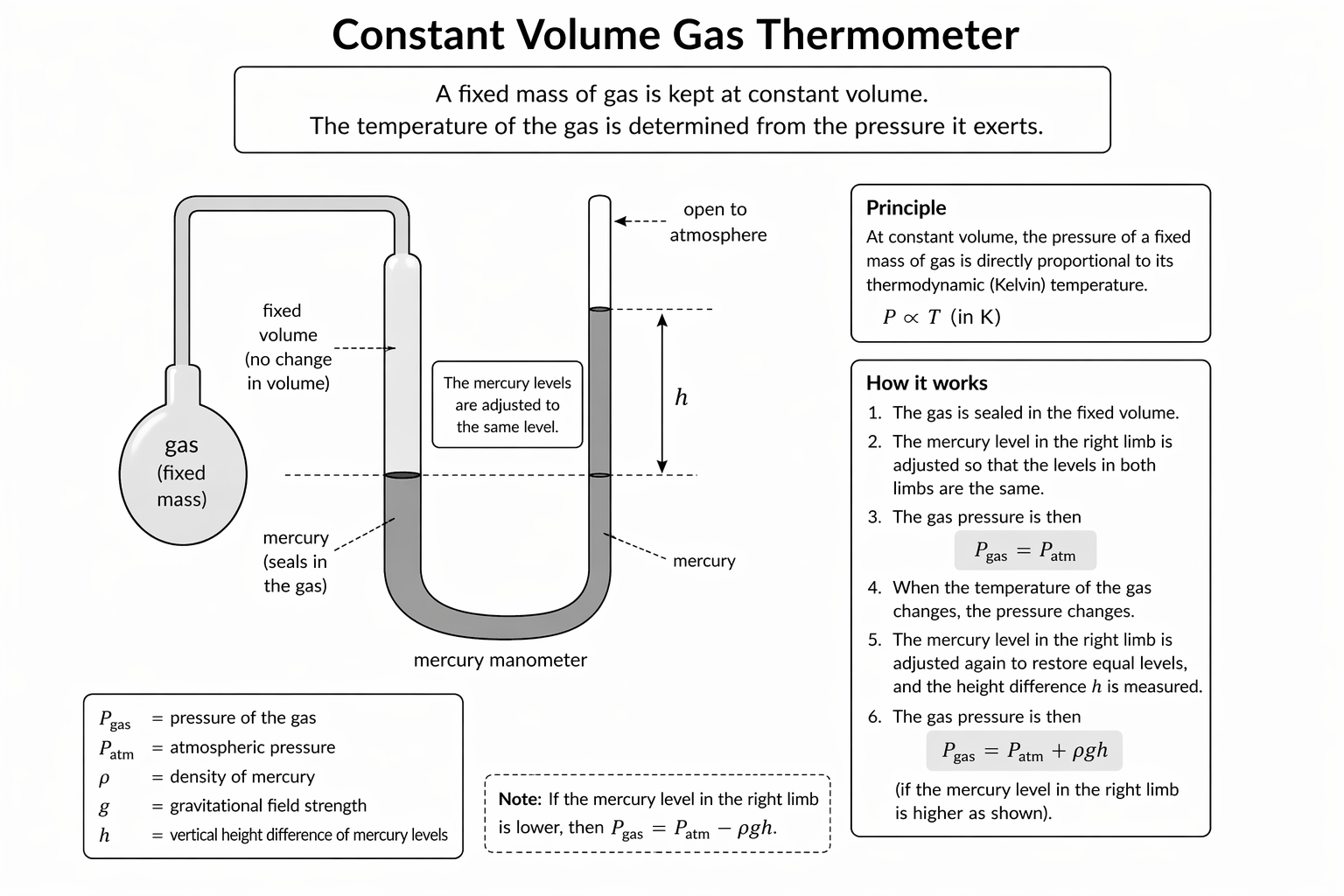
Figure 1. A fixed mass of gas is enclosed in a bulb connected to a narrow capillary tube and a mercury manometer. The capillary tube is narrow, so changes in the mercury level produce negligible changes in gas volume, allowing the gas to be treated as approximately constant volume. As the temperature changes, the gas pressure changes, producing a height difference in the manometer.
For the arrangement shown,
where:
- = density of mercury
- = gravitational field strength
- = vertical height difference between mercury levels
Since the gas volume is approximately constant, by the ideal gas law:
Therefore, the height difference varies approximately linearly with temperature and may be used as a thermometric property.
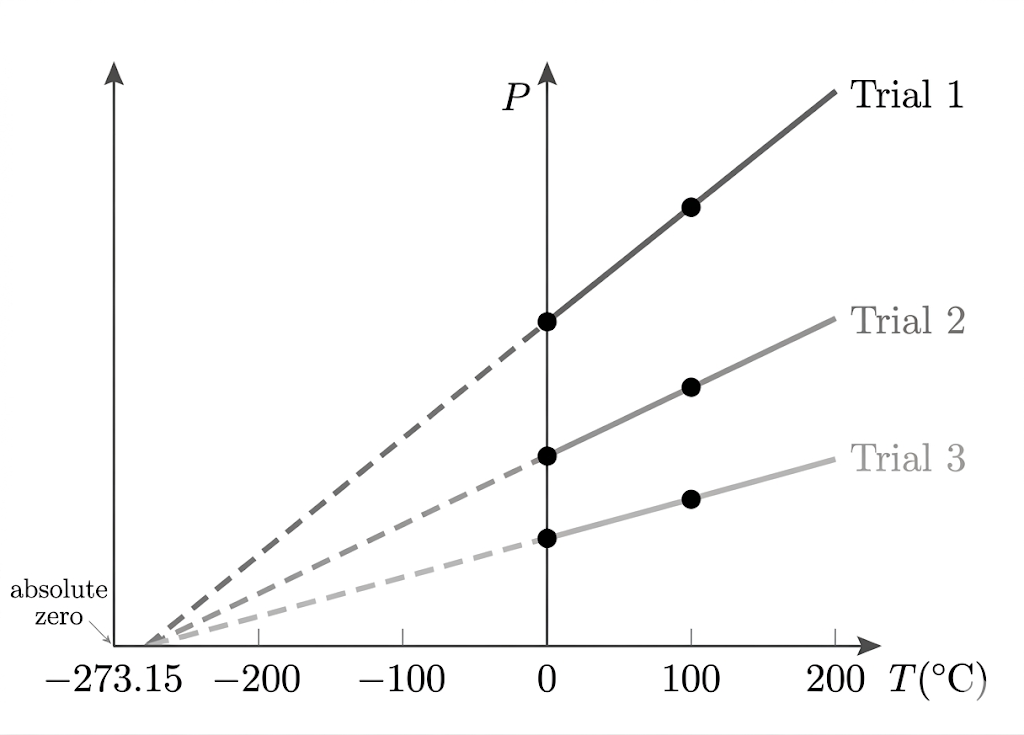
Figure 2. Extrapolating a constant-volume gas thermometer graph to zero pressure leads to the absolute-zero temperature.
Zeroth Law of Thermodynamics
If:
- A is in thermal equilibrium with C
- B is in thermal equilibrium with C
Then:
- A is in thermal equilibrium with B
This law justifies the use of thermometers.
Heat Capacity and Specific Heat Capacity
Heat supplied to an object causing temperature rise:
Where:
- = thermal energy supplied
- = heat capacity
Heat capacity is the thermal energy required to raise the temperature of an object by .
Unit:
Large heat capacity means the temperature changes only a little for a given energy input. Water is the classic example.
For the same material, the amount of heat required to raise the temperature by is proportional to the mass of the object. Therefore, heat capacity describes a particular object, not the intrinsic thermal property of the material itself.
A more suitable quantity for describing the material is the heat capacity per unit mass:
This is called the specific heat capacity.
For mass :
Where:
- = specific heat capacity
Specific heat capacity is the thermal energy required to raise the temperature of 1 kg of a substance by 1 K.
Unit:
See Heat Capacity and Latent Heat.
Calorimetry and Mixing
For an insulated system containing multiple interacting bodies, thermal energy transferred from hotter parts equals the thermal energy gained by cooler parts.
This follows from conservation of energy, since no energy is transferred between an insulated system and the surroundings.
Typical examples:
- hot metal placed in cold water
- mixing liquids
- final equilibrium temperature
If a calorimeter is part of the setup, its heat capacity must be included unless the question says it is negligible.
Worked Example 1: Mixing
In an insulated system, a block of metal at is placed in water. Water gains . Find heat lost by metal.
Since insulated:
Latent Heat
During melting or boiling:
- temperature remains constant
- energy changes molecular arrangement instead of kinetic energy
Formula
Where:
- = mass
- = specific latent heat
Unit:
Types of Specific Latent Heat
Fusion
Energy required per kg to convert:
- solid liquid
at constant temperature.
Vaporisation
Energy required per kg to convert:
- liquid gas
at constant temperature.
Usually:
because particles separate much more in gas state.
Heating Curves
Typical heating curve:
- solid warms
- melting plateau
- liquid warms
- boiling plateau
- gas warms
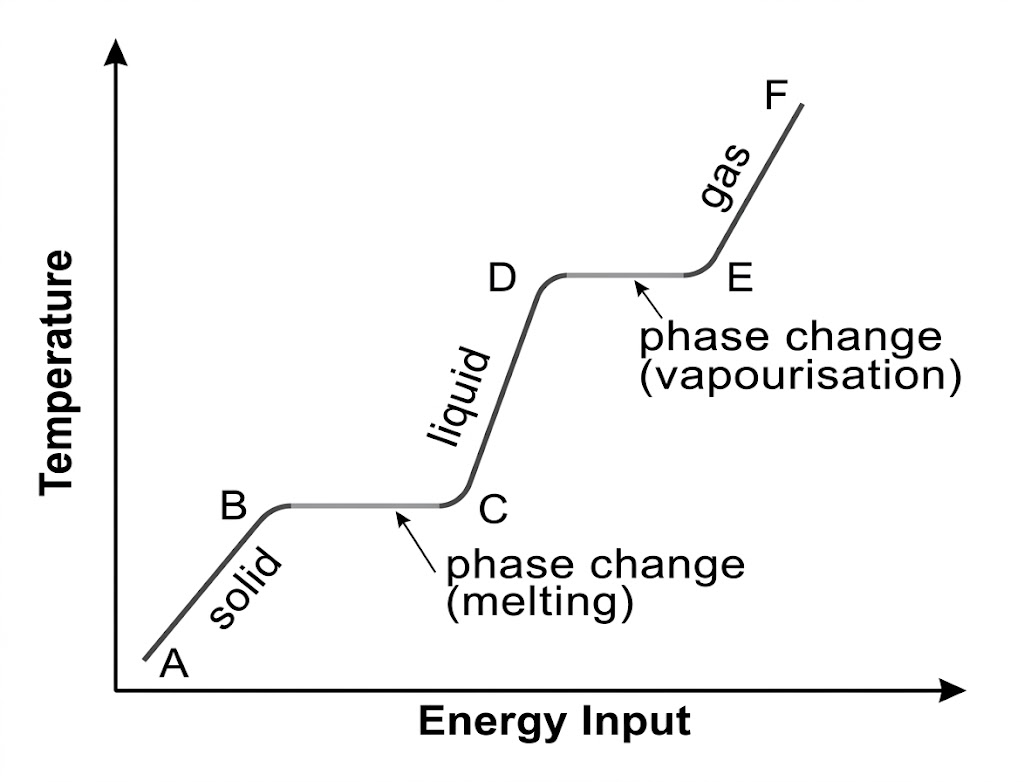
Figure 3. Heating curve showing the variation of temperature with energy input during heating. Along the sloped sections A→B, C→D, and E→F, the temperature increases within a single phase, so applies, where is the specific heat capacity of the phase. Along the horizontal sections B→C and D→E, phase changes occur at constant temperature, so applies, where is the specific latent heat associated with the phase transition.
For a given heating power, the plateau length depends on both the mass of the substance and the relevant specific latent heat.
Interpretation
Sloping region:
- temperature rises
- use
Flat region:
- temperature constant
- use
Worked Example 2: Melting Ice
How much energy to melt ice at ?
Given:
Then:
Practical Methods Overview
Electrical heating supplies energy:
Where:
- = current
- = p.d.
- = time
For a solid metal block:
Hence:
For latent heat practicals:
with corrections for heat loss when needed.
See Thermal Practicals.
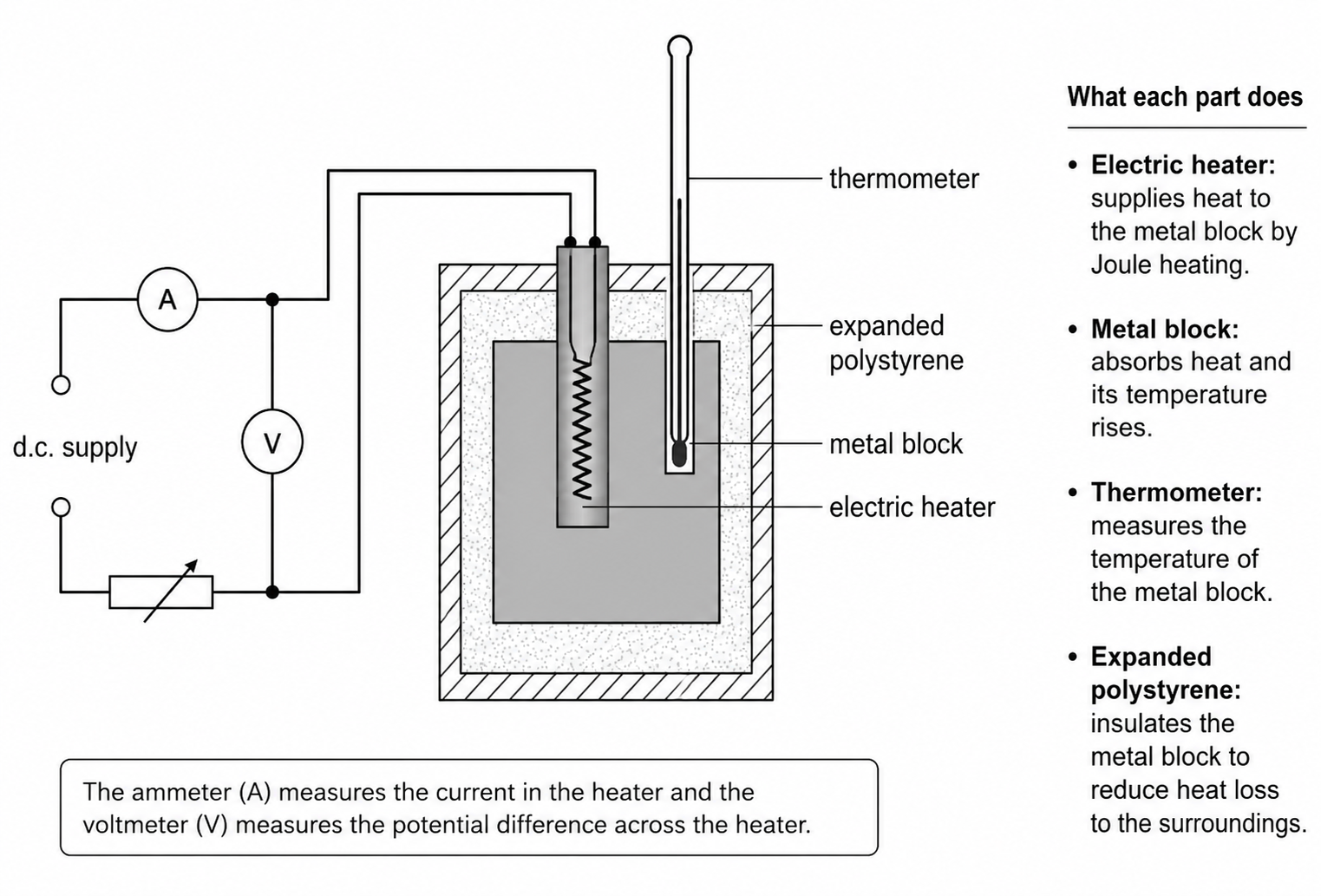
Figure 4. Electrical input energy is matched to the thermal energy gained by the sample in the standard specific-heat-capacity setup.
The same electrical method can be adapted for latent-heat experiments, but the analysis must account for any heat lost to the surroundings.
Worked Example 3: Heater Problem
A heater rated runs for 5 min.
Find energy supplied.
Formula Summary
Temperature Conversion
Heat Capacity
Specific Heat Capacity
Latent Heat
Electrical Heating
Electrical SHC Determination
Common Exam Pitfalls
1. Heat vs Temperature
Heat = transferred energy.
Temperature = measure of hotness.
2. Celsius vs Kelvin
Use Kelvin where absolute temperature is needed.
3. Forgetting Constant Temperature in Phase Change
During melting or boiling:
- temperature does not rise
4. Wrong Units
Convert:
- g to kg
- min to s
- kW to W
5. Heat Capacity vs Specific Heat Capacity
- : whole object
- : per kg
6. Assuming No Heat Loss Automatically
Only if stated insulated or negligible losses.
For a full checklist see Thermal Physics A Common Exam Traps.
Links
- Work, Energy and Power
- Thermal Measurement and Scales
- Heat Capacity and Latent Heat
- Thermal Practicals
- Thermal Physics A Common Exam Traps
Summary
Thermal Physics A is fundamentally about deciding what the supplied energy is doing:
- setting thermal equilibrium and temperature scales
- raising temperature
- changing state
- or being measured electrically in practical work
Strong performance comes from choosing the correct thermal model for each stage and keeping definitions precise.