Current Electricity Fundamentals
Overview
Current electricity is the study of charge flow and energy transfer in electrical circuits. The core ideas here are the rate of flow of charge, the direction convention used for current, the difference between emf and potential difference, and the way real conductors and real sources depart from the ideal model.
This page is the primary teaching surface for Topic 13. Supporting pages deepen only selected subtopics.
This topic focuses on:
- charge and current
- conventional current and electron flow
- potential difference and emf
- resistance and Ohm’s law
- I-V characteristics
- resistivity and geometry
- internal resistance and lost volts
- electrical power and appliance ratings
Related support notes:
- I-V Characteristics
- Internal Resistance
- Resistivity and Materials
- Electrical Power and Ratings
- Current Electricity Common Exam Traps
Core Ideas
- current is the rate of flow of charge
- conventional current follows the direction positive charge would move
- emf is energy supplied per unit charge by a source
- potential difference is energy transferred per unit charge between two points
- resistance is defined by the ratio , while Ohm’s law is the special proportionality for ohmic conductors at constant temperature
- real components can be non-ohmic
- resistance depends on material and geometry through resistivity
- real sources have internal resistance, so terminal p.d. can be less than emf
- power is the rate of electrical energy transfer
Exam Relevance
This topic is the foundation for later DC-circuit work. Most errors come from mixing up current direction, confusing emf with terminal p.d., applying Ohm’s law too broadly, or choosing the wrong power relation.
Charge and Current
Electric Charge
Charge is measured in coulombs, . The elementary charge is:
Charge can be positive or negative. In metals, the charge carriers are electrons.
Electric Current
Electric current is the rate of flow of electric charge through a cross-section:
More generally, the instantaneous current is:
For steady current:
In circuit analysis, current is usually treated as a signed scalar. A positive current means that charge flow is in the chosen reference direction, while a negative current means that the actual conventional current is opposite to the chosen direction.
Link to Mobile Charge Density and Drift Speed
For a conductor with cross-sectional area , mobile charge carrier number density , charge per carrier , and drift speed :
Hence:
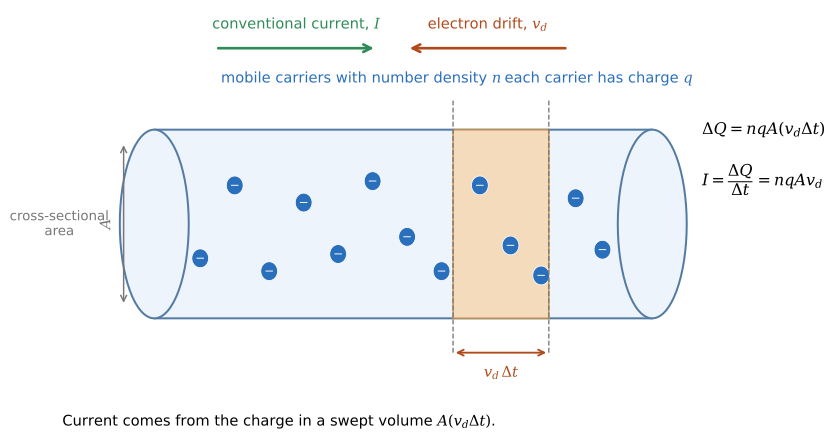 The swept volume $A(v_d\Delta t)$ contains charge $nqA(v_d\Delta t)$, giving $I=nqAv_d$.
This shows that current depends on how many mobile charge carriers are available, how much charge each carries, the cross-sectional area of the conductor, and the average drift speed of the carriers.
For metals, the mobile charge carriers are electrons, but the conventional current direction is opposite to the direction of electron drift.
Conventional Current vs Electron Flow
Conventional current is defined as the direction positive charge would move. In a metal wire, electrons drift in the opposite direction.
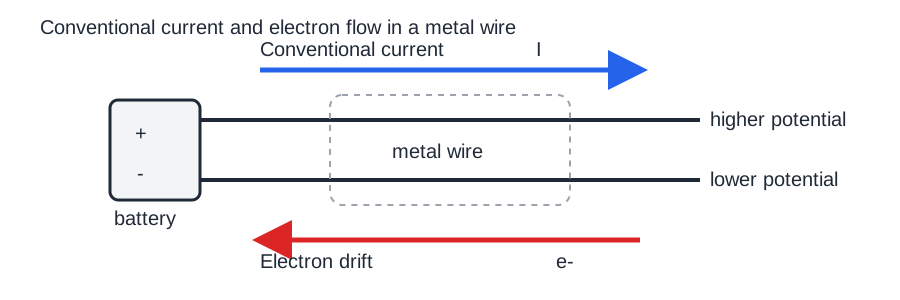 Conventional current follows positive charge convention; electron drift in metals is opposite.
In non-metallic media such as gases, electrolytes, and semiconductors, current can involve more than one kind of carrier. The current convention still does not change.
Potential Difference and emf
Potential Difference
The potential difference between two points in a circuit is the electrical energy transformed to other forms per unit charge as charge passes from one point to the other:
where is the electrical energy transformed to other forms when charge passes between the two points.
So:
Electromotive Force
The electromotive force, or emf, of a source is the non-electrical energy transformed into electrical energy per unit charge passing through the source:
where is the work done by the source in transforming non-electrical energy into electrical energy.
It is a property of the source, not of the load.
emf vs Terminal p.d.
When current flows, the terminal p.d. of a real source is less than its emf because some energy is dissipated inside the source.
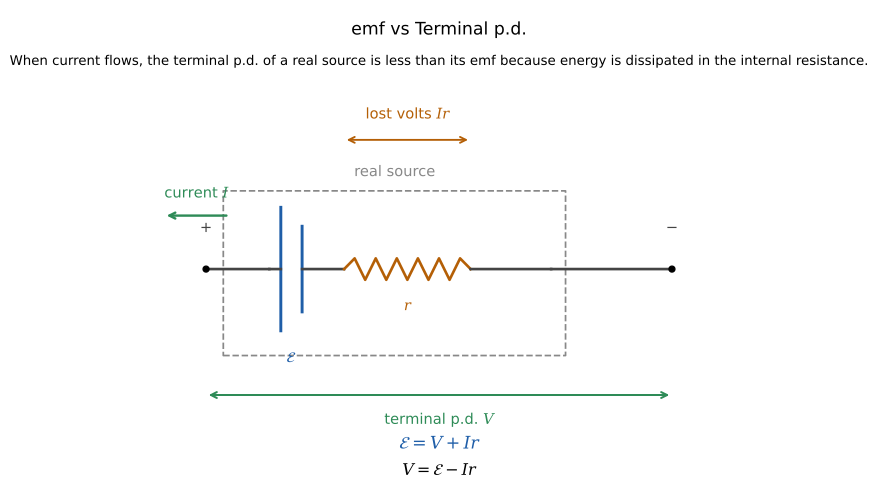 A real source can be modeled as emf in series with internal resistance, so the terminal p.d. is the emf minus the lost volts.
Resistance and Ohm’s Law
Resistance
Resistance measures opposition to current flow:
Unit:
Ohm’s Law
For an ohmic conductor at constant temperature:
That means is constant, so:
That linear relation is not universal. It only holds for ohmic behaviour under the stated conditions.
I-V Characteristics
An I–V characteristic is a graph of current against potential difference . It shows whether a component is ohmic or non-ohmic, and how its resistance changes as operating conditions change.
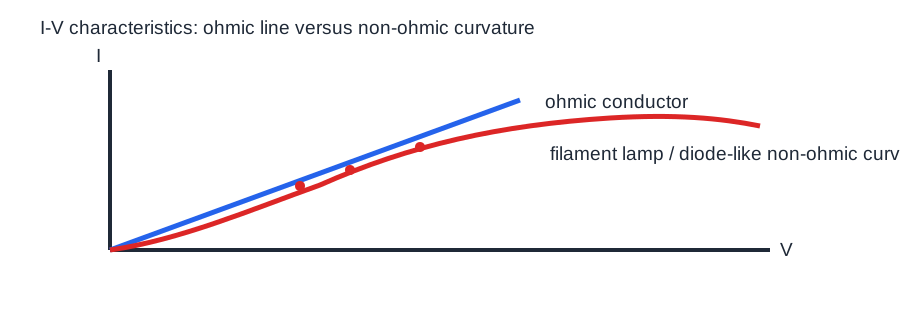 A straight line through the origin indicates ohmic behaviour under constant physical conditions. A curved I–V graph indicates that resistance is changing.
Key patterns:
- metallic conductor at constant temperature: straight line through the origin; resistance is constant
- filament lamp: curve flattens as the filament heats up and resistance rises
- semiconductor diode: strongly asymmetric I–V characteristic; large current flows only in forward bias after sufficient forward p.d.
- negative temperature coefficient thermistor: resistance falls as temperature rises
Resistivity and Geometry
Resistance depends on both the material and the dimensions of the conductor:
where:
- is resistivity
- is length
- is cross-sectional area
Longer wires have greater resistance; thicker wires have smaller resistance for the same material.
Resistivity is a material property. It does not depend on the size of the sample, but it does depend on the material and temperature.
Internal Resistance
A real source has internal resistance . If current flows, then:
so:
The quantity is the lost volts inside the source.
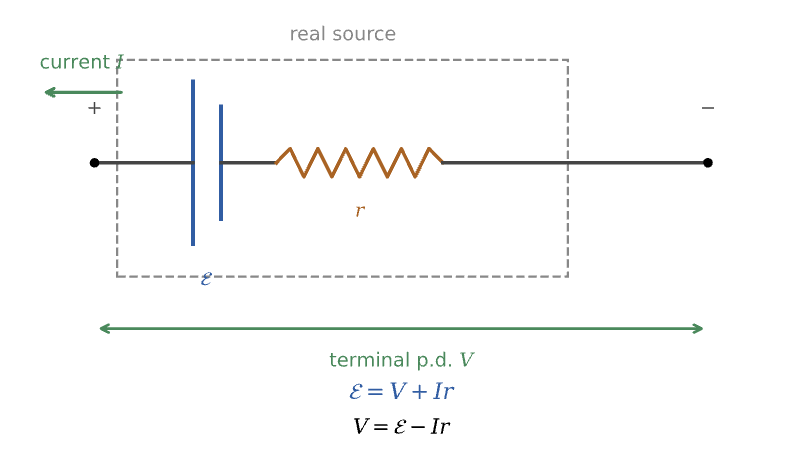
Terminal p.d. falls below emf because some energy is dissipated inside the source.
This model explains why:
- terminal p.d. falls when current rises
- sources heat up under load
- the open-circuit voltage can be close to the emf
- short circuits are dangerous
Electrical Power
Electrical power is the rate of electrical energy transfer:
For a resistor:
and:
Energy transferred in time is:
For an appliance rating, the quoted power is the operating power when the appliance is connected to its rated potential difference.
Worked Examples
Current from Charge Flow
If passes a point in :
Resistance
If a component has and :
Power
If a heater draws from a supply:
Internal Resistance
If , , and :
Exam Reasoning
When answering questions, check:
- what the quantity actually means
- whether the component is ohmic
- whether temperature is assumed constant
- whether the source is ideal or real
- whether the p.d. asked for is terminal p.d. or emf
- whether the correct power formula matches the known quantities
Common Exam Traps
- confusing emf with terminal p.d.
- treating Ohm’s law as universal
- reversing electron flow and conventional current
- mixing resistance and resistivity
- choosing the wrong power equation
- reading graph gradients without checking axis labels
For the compact trap sheet, see Current Electricity Common Exam Traps.
Quick Revision Summary
- Electric current: , and more generally
- For steady current:
- Potential difference:
- Electromotive force: for a source
- Resistance:
- Ohm’s law: only for ohmic conductors under constant physical conditions
- Resistivity:
- Electrical power:
- For resistive components:
- Energy transferred in time :
- Real source with internal resistance: