Nuclear Fission
Overview
Nuclear Fission is the splitting of a heavy nucleus into two lighter nuclei. In reactor contexts, it is usually initiated when a fissile nucleus absorbs a neutron.
The essential H2 Physics idea is:
A heavy nucleus absorbs a neutron and forms an excited unstable nucleus. The nucleus undergoes fission into smaller daughter nuclei that are more tightly bound (higher binding energy per nucleon). The increase in total binding energy is released as energy, together with additional neutrons.Fission is not simply “splitting releases energy”. Energy is released because the products have greater total binding energy and lower total mass than the reactants.
This topic links closely with:
Core Ideas
- A heavy nucleus may undergo fission after absorbing a neutron.
- The fission products are usually medium-mass nuclei, together with neutrons and released energy.
- Energy is released because the fission products have greater binding energy per nucleon and are therefore more tightly bound.
- The emitted neutrons may trigger further fission reactions, producing a chain reaction.
- Not all emitted neutrons continue the chain reaction; some escape or are absorbed without causing fission.
- Nuclear reactors use separate systems to control the neutron population and to remove thermal energy from the reactor core.
What Is Fission?
Fission occurs when a heavy nucleus splits into two medium-mass nuclei.
General features:
- often triggered by absorption of a neutron
- a short-lived unstable compound nucleus forms briefly
- daughter nuclei are produced
- additional neutrons are emitted
- energy is released, mainly as kinetic energy of the fission fragments and emitted neutrons
Fission differs from ordinary radioactive decay because the standard reactor example is an induced nuclear reaction initiated by neutron absorption, rather than spontaneous alpha, beta, or gamma decay.
Typical Example: Uranium-235
A common teaching example of fission is:
Here is a fission example that proceeds through an unstable uranium-236 compound nucleus:
Many different fission product combinations are possible. The important general pattern is neutron absorption, formation of an unstable compound nucleus, splitting into medium-mass nuclei, emission of neutrons, and release of energy.
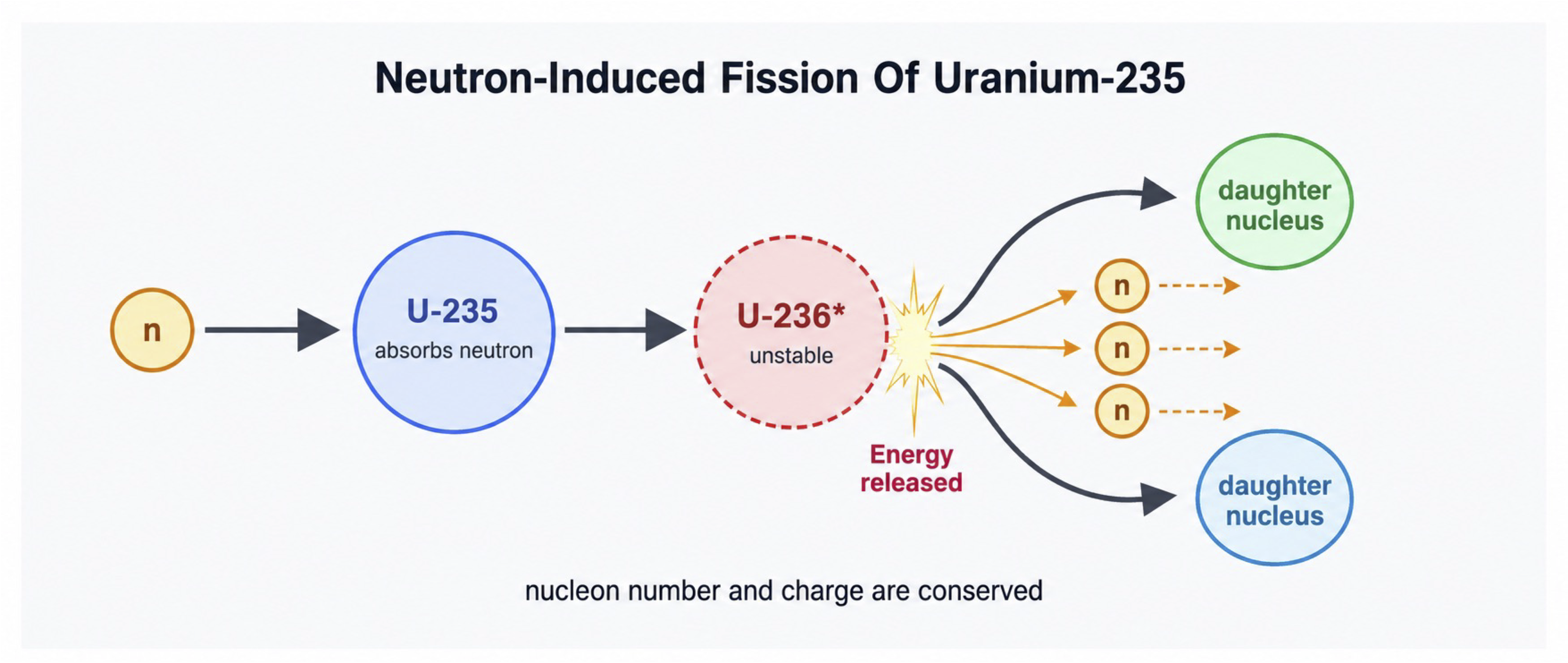
Figure: Neutron-induced fission of uranium-235 forms an unstable nucleus that splits into daughter nuclei, neutrons, and released energy.
Conservation Checks
In nuclear reactions:
- proton number is conserved
- nucleon number is conserved
- momentum is conserved
- total mass-energy is conserved
For the Ba-Kr example:
| Quantity | Reactants | Products | Conserved? |
|---|---|---|---|
| Nucleon number | Yes | ||
| Proton number | Yes |
Why Neutrons Are Used
Neutrons are useful because they carry no electric charge.
Therefore:
- they are not repelled by the positively charged nucleus
- they can approach and enter the nucleus more easily than charged projectiles
- in suitable fuels, they can induce fission
In many reactor contexts, slow thermal neutrons are especially effective at causing fission in uranium-235.
Why Energy Is Released
Mass Defect Explanation
The total mass after fission is less than the total mass before fission:
The missing mass appears as released energy:
Binding Energy Explanation
Very heavy nuclei have lower binding energy per nucleon than many medium-mass nuclei.
After fission:
- the daughter nuclei are more tightly bound
- the total binding energy increases
- energy is released
So:
Do not say energy is released simply because the nucleus splits. The energy release is due to the increase in total binding energy, equivalently the mass defect.
Binding Energy Per Nucleon And Fission
The binding-energy-per-nucleon curve has a maximum near iron-56. Very heavy nuclei lie on the right side of the curve, where the binding energy per nucleon is lower.
When a very heavy nucleus splits into medium-mass nuclei closer to the peak:
- the products have greater binding energy per nucleon
- the products are more stable
- energy is released
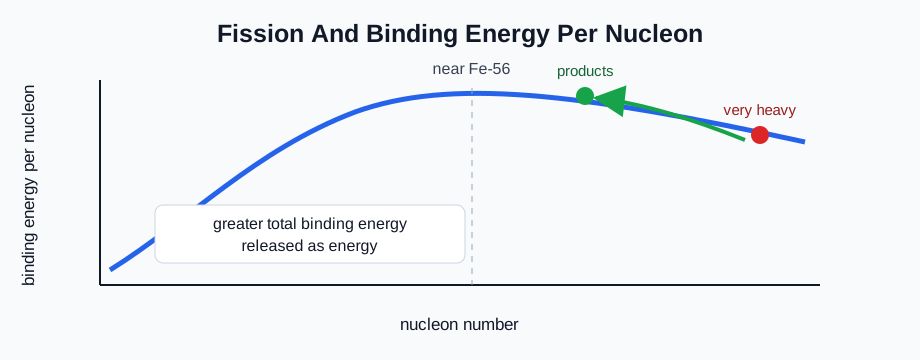
Figure: Fission can release energy when a very heavy nucleus splits into products closer to the high-binding-energy region.
This figure is qualitative. It should not be used to read numerical binding energies.
Chain Reaction Overview
The extra neutrons from one fission event may trigger further fission events.
This is a chain reaction:
one fission -> emitted neutrons -> more fissions -> more emitted neutronsHowever, not every emitted neutron continues the chain.
Possible neutron outcomes:
- causes another fission
- escapes the fuel
- is absorbed without causing fission
- is absorbed by control rods
- is slowed by a moderator before later causing fission
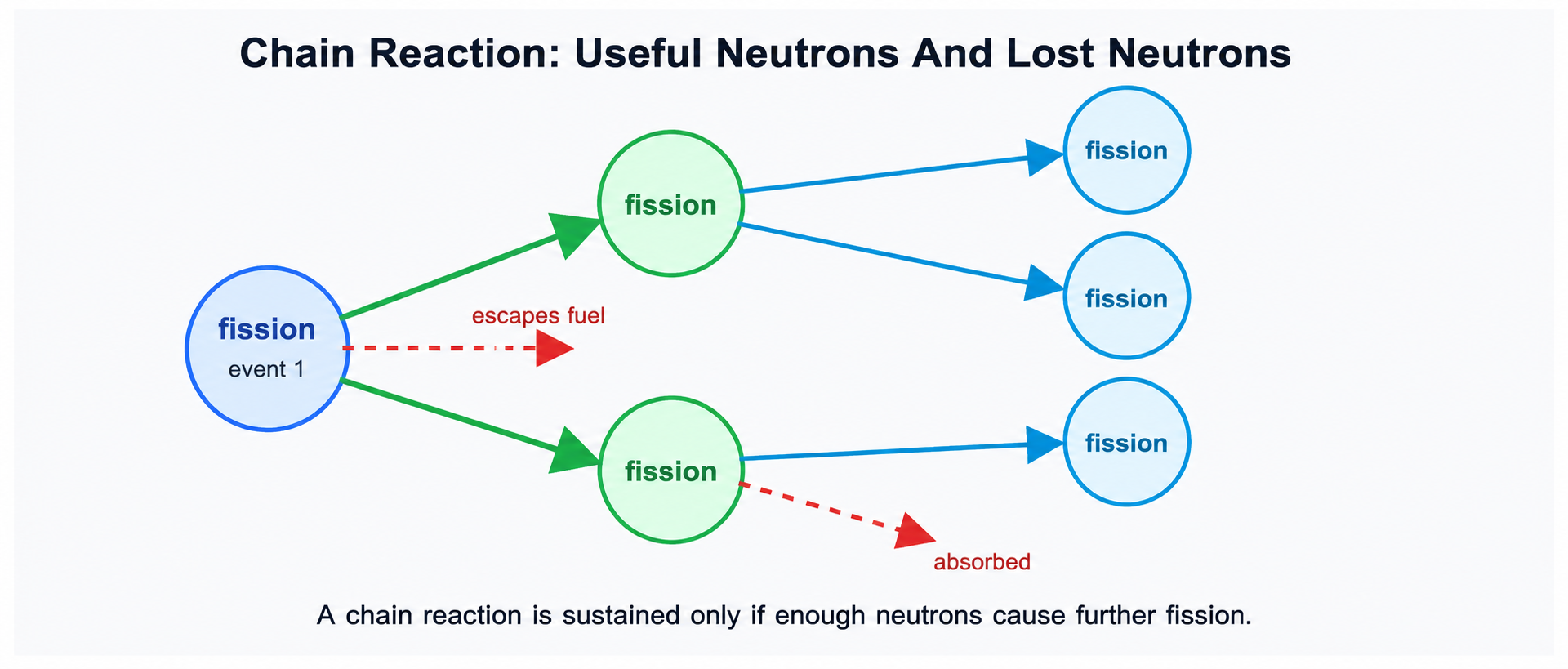
Figure: A fission chain reaction grows only if enough emitted neutrons cause further fissions; some neutrons are lost or absorbed.
For a fuller discussion of neutron multiplication, criticality, and reactor-component roles, see Chain Reactions and Reactors.
Criticality
Criticality describes whether enough neutrons continue the chain reaction.
| State | Meaning | Result |
|---|---|---|
| Subcritical | Too few useful neutrons continue | Reaction rate decreases |
| Critical | Just enough useful neutrons continue | Reaction rate steady |
| Supercritical | More than enough useful neutrons continue | Reaction rate increases |
In reactor operation, “critical” can mean steady controlled power. It does not automatically mean an explosion.
Controlled vs Uncontrolled Fission
Controlled Fission
Controlled fission occurs in nuclear reactors.
- reaction rate is regulated
- heat is removed continuously
- power output is kept steady
- control rods adjust the neutron population
Uncontrolled Fission
Uncontrolled fission occurs when the chain reaction grows rapidly.
- reaction rate increases very fast
- energy is released in a short time
Keep the comparison qualitative; detailed weapons engineering is outside this topic.
Nuclear Reactor Overview
A nuclear reactor uses a controlled fission chain reaction to generate heat, which is then used to produce electricity.
Main sequence:
- fission releases energy in the reactor core
- a coolant transfers thermal energy away from the core
- the thermal energy produces steam directly or indirectly
- the steam drives a turbine
- the turbine drives a generator
Reactor Components and Roles
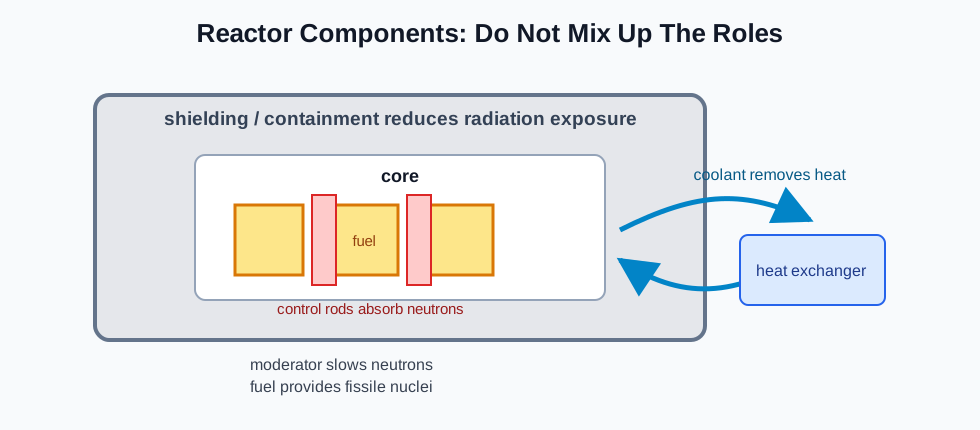
Figure: Fuel fissions, moderator slows neutrons, control rods absorb neutrons, coolant removes heat, and shielding reduces radiation exposure.
| Component | Main Role | Common Confusion |
|---|---|---|
| Fuel | Provides fissile nuclei such as uranium-235 or plutonium-239 | Not the same as moderator |
| Moderator | Slows fast neutrons into thermal neutrons | Does not mainly absorb neutrons |
| Control rods | Absorb neutrons to regulate reaction rate | Do not remove heat directly |
| Coolant | Transfers heat away from the core | Does not control neutrons directly |
| Shielding | Reduces radiation exposure | Does not carry heat away |
Advantages of Nuclear Fission
- very large energy output from a small mass of fuel
- low direct carbon dioxide emissions during operation
- reliable base-load electricity generation
- relatively small fuel transport volume compared with fossil fuels
Disadvantages and Challenges
- radioactive waste disposal
- accident risk if cooling or containment fails
- high construction and decommissioning cost
- security and proliferation concerns
- possible thermal pollution
Safety and Waste Overview
Fission reactors require:
- shielding
- emergency shutdown systems
- cooling systems
- containment structures
- secure spent-fuel management
Spent fuel and some reactor materials remain radioactive and require careful long-term handling.
See Ionizing Radiation and Safety.
Short Worked Examples
Example 1: Why Use Neutrons Rather Than Protons?
Neutrons are uncharged, so they are not repelled by the positively charged nucleus.
Example 2: Why Does Fission Release Energy?
The products have greater total binding energy and lower total mass. The mass defect is released as energy according to:
Example 3: Why Are Control Rods Needed?
Control rods absorb neutrons. Inserting them reduces the number of neutrons available to continue the chain reaction.
Example 4: Why Do Some Reactors Need Moderators?
Fast neutrons from fission are slowed by a moderator. Slow neutrons can be more effective at inducing further fission in fuels such as uranium-235.
Example 5: Estimating Energy Released From Binding Energy Per Nucleon
For the reaction:
suppose the binding energy per nucleon values are:
| Nucleus | Binding energy per nucleon |
|---|---|
The approximate energy released is:
The free neutrons are not included in this binding-energy calculation because a free neutron is not bound inside a nucleus.
Exam Relevance
Students should be able to:
- describe a typical neutron-induced fission reaction
- explain energy release using mass defect and binding energy
- explain why neutrons are useful in fission
- distinguish subcritical, critical, and supercritical behavior qualitatively
- distinguish moderator, control rods, coolant, and shielding
- explain why not all emitted neutrons continue the chain reaction
Formula / Relationship Summary
Mass-Energy
Binding-Energy Method
Fission Pattern
Common Exam Traps Overview
Students often confuse:
- fission with radioactive decay
- moderator with control rods
- coolant with shielding
- energy release with “nucleus splits, so energy appears”
- chain reaction with every neutron always causing another fission
- critical reactor operation with a bomb reaction
See Nuclear Fission Common Exam Traps.
Quick Revision Summary
- fission splits a heavy nucleus into medium-mass nuclei
- reactor fission is usually neutron-induced
- energy release comes from mass defect and increased total binding energy
- emitted neutrons can sustain a chain reaction
- not all neutrons continue the chain
- moderator slows neutrons
- control rods absorb neutrons
- coolant removes heat
- shielding reduces radiation exposure