Nuclear Fusion
Overview
Nuclear Fusion is the joining of light nuclei to form a heavier nucleus. It powers stars and is studied as a possible future energy source on Earth.
The essential H2 Physics idea is:
light nuclei combine -> products have greater binding energy per nucleon -> total mass decreases -> energy is releasedFusion is not simply “nuclei join, so energy appears”. The energy comes from a decrease in total mass and an increase in total binding energy.
This topic links closely with:
Core Ideas
- Fusion combines light nuclei to form a heavier nucleus.
- The products can have greater binding energy per nucleon than the reactants.
- The total mass after the reaction is lower than before the reaction.
- The released energy is given by .
- Positively charged nuclei repel each other, so very high temperatures are needed for fusion.
- At fusion temperatures, the fuel exists as a plasma.
- Useful controlled fusion requires sufficient heating, density, and confinement at the same time.
What Is Fusion?
Fusion occurs when two light nuclei come close enough for the short-range strong nuclear force to bind them into a heavier nucleus.
Two competing interactions are important:
- electrostatic repulsion between positively charged nuclei acts over a relatively long range
- the strong nuclear force is attractive but acts only over a very short range
Before fusion can occur, the nuclei must come close enough for the strong nuclear force to dominate.
Fusion differs from fission:
| Process | Basic Change | Typical Region | Energy Reason |
|---|---|---|---|
| Fusion | Light nuclei combine | Low nucleon number | Products have greater binding energy per nucleon |
| Fission | Heavy nucleus splits | High nucleon number | Daughter nuclei have greater binding energy per nucleon |
Typical Example: Deuterium-Tritium Fusion
A common fusion reaction is:
where:
- is deuterium
- is tritium
- is a helium-4 nucleus
- is a neutron
- is the released energy
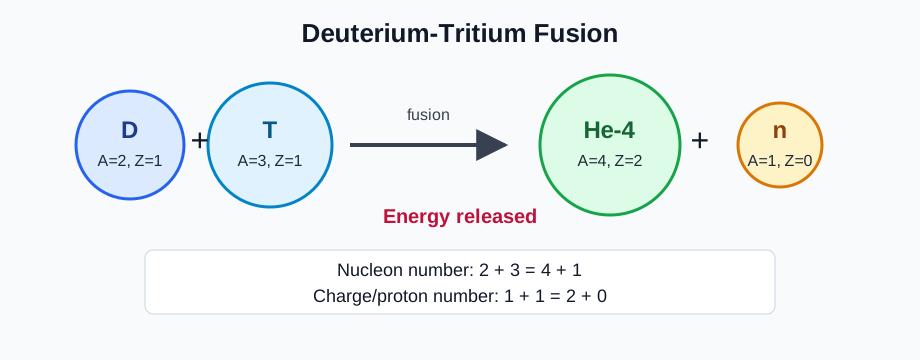
Figure: Deuterium and tritium fuse to form helium-4, a neutron, and released energy, while conserving nucleon number and proton number.
Conservation checks:
| Quantity | Reactants | Products | Conserved? |
|---|---|---|---|
| Nucleon number | Yes | ||
| Proton number / charge | Yes |
The neutron is not a side detail: it is one of the products and can carry substantial kinetic energy. It also creates engineering and shielding issues in real reactors.
Why Energy Is Released
Mass Defect Explanation
For the D–T reaction, the total mass of the products is less than the total mass of the reactants:
The missing mass appears as released energy:
Using the source-note values:
This corresponds to about:
When atomic masses are used for this reaction, the electron masses cancel: the deuterium and tritium atoms contain two electrons in total, and the helium atom also contains two electrons.
Binding Energy Explanation
Binding energy is the energy needed to separate a nucleus completely into its nucleons.
Binding energy per nucleon tells us how tightly bound the average nucleon is. A greater value means a more stable, more tightly bound nucleus.
For fusion of light nuclei:
- reactants are light nuclei with relatively low binding energy per nucleon
- the product nucleus is more tightly bound
- total binding energy increases
- the increase in binding energy is released as energy
So the same energy release can be calculated as:
The source note evaluates the D–T reaction using binding energies and obtains about:
The small difference from the mass calculation is due to rounding.
Binding Energy Per Nucleon And Fusion
The binding-energy-per-nucleon curve rises steeply for light nuclei and reaches a maximum near iron-56.
For Topic 31, the key part is the left side of the curve:
- light nuclei can fuse into a heavier product
- the product is closer to the high-binding-energy region
- the product is more tightly bound
- energy is released
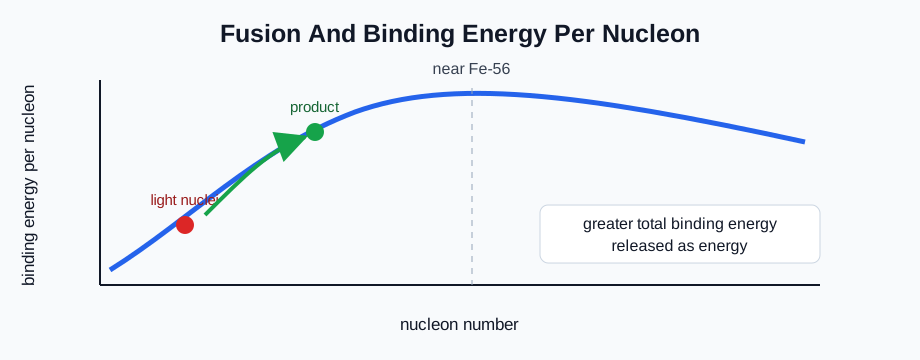
Figure: Fusion of suitable light nuclei releases energy when the products move toward a region of greater binding energy per nucleon.
Keep the reasoning precise:
Fusion releases energy when the final products have greater total binding energy than the initial nuclei.This figure is qualitative. It shows why suitable light nuclei can release energy by fusion; it is not a precise graph for reading numerical binding energies.
Why Very High Temperature Is Needed
Nuclei are positively charged, so they repel each other through the Coulomb force.
For fusion to occur, nuclei must approach closely enough for the strong nuclear force to act. This requires some collisions to have very high kinetic energy.
Temperature is related to the average kinetic energy of particles. Therefore, very high temperature helps because nuclei move faster on average.
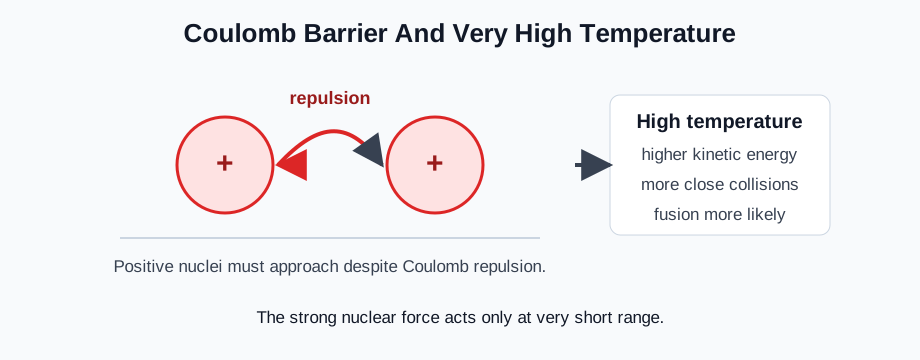
Figure: Positive nuclei repel each other, so very high temperature is needed for some collisions to bring nuclei close enough for fusion.
The source note includes a discussion question referring to deuterium fusion temperatures of order:
The exact value is less important here than the qualitative point:
very high temperature -> high kinetic energy -> better chance of close nuclear encountersHowever, high temperature alone is not enough. The fuel must also remain dense and confined long enough.
Plasma
At fusion temperatures, atoms are ionised. The fuel becomes plasma, containing:
- positive ions
- free electrons
Plasma is not an ordinary hot gas in a container. It is electrically conducting, responds to magnetic fields, and would damage ordinary material walls if it touched them at fusion temperatures.
Confinement
Confinement means keeping the hot fusion fuel together long enough for useful fusion reactions to occur.
Fusion fuel must satisfy three linked requirements:
- high temperature
- sufficient density
- sufficient confinement time
If the plasma escapes or cools too quickly, too few reactions occur and the system does not produce useful net energy.
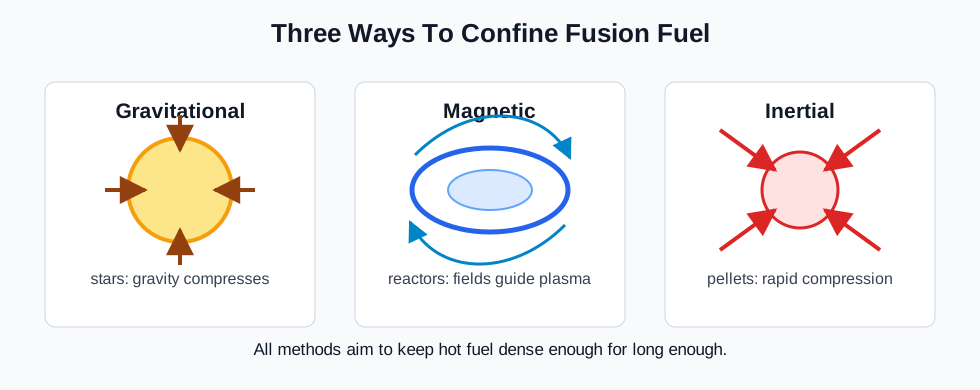
Figure: Gravitational, magnetic, and inertial confinement all aim to keep hot fusion fuel dense enough for long enough.
For a fuller discussion of the confinement problem and why heating alone is not enough, see Fusion Conditions and Confinement.
Gravitational Confinement
Stars use gravity.
Their enormous mass compresses material toward the core, giving:
- very high pressure
- high density
- sustained high temperature
This is why stars can sustain fusion over long timescales.
Magnetic Confinement
On Earth, one approach is to use magnetic fields to guide and confine charged plasma.
Examples include:
- tokamaks
- stellarators
The aim is to keep the plasma away from reactor walls while maintaining suitable temperature and density.
Inertial Confinement
Another approach is to compress a small fuel pellet very rapidly using intense energy beams such as lasers.
The compression produces:
- very high density
- high temperature
- a very short fusion burst
The difficulty is that compression must be extremely symmetric and precisely timed.
Fusion In Stars
Stars are powered by fusion in their cores.
The Sun mainly converts hydrogen into helium through a sequence of reactions. In school-level treatment, the important point is not the full stellar reaction chain, but that nuclear fusion releases energy on a scale that chemical burning cannot explain.
Gravity provides the confinement and compression needed for stellar fusion.
Fusion Reactors
A controlled fusion reactor aims to reproduce useful fusion on Earth.
The simplified sequence is:
- heat fusion fuel until it becomes plasma
- confine the plasma
- allow fusion reactions to occur
- transfer released energy to a working fluid or blanket
- generate electricity
The main challenge is achieving reliable net energy gain while maintaining stable confinement and handling energetic neutrons.
Advantages of Fusion
Fusion is attractive because it can offer:
- very high energy output per mass of fuel
- fuel sources such as deuterium that are relatively abundant
- no carbon dioxide emission during operation
- no fission-type runaway neutron chain reaction
- generally less long-lived high-level waste than many fission systems
Challenges and Limitations
Fusion is difficult because:
- extremely high temperature is required
- plasma confinement is technically hard
- plasma can become unstable
- energy losses may exceed energy produced
- high-energy neutrons can damage materials
- commercial-scale net energy production remains a major engineering challenge
Safety and Waste Comparison with Fission
Fusion generally does not rely on the same self-sustaining neutron chain reaction as fission reactors. If the necessary temperature and confinement conditions fail, fusion stops.
However, fusion is not radiation-free. It can involve:
- energetic neutrons
- gamma radiation in some reactions
- activation of nearby materials
- shielding and remote-handling requirements
See Ionizing Radiation and Safety.
Short Worked Examples
Example 1: Why High Temperature Is Needed
Positively charged nuclei repel each other. Very high temperatures give nuclei high kinetic energy, so some collisions bring nuclei close enough for the short-range strong nuclear force to bind them.
Example 2: Why Energy Is Released
The products are more tightly bound than the reactants. Their total mass is lower, and the mass defect is released as energy according to:
Example 3: Why Stars Sustain Fusion
Gravity compresses stellar material and maintains high pressure, density, and temperature in the core.
Example 4: Why A Fusion Reactor Is Difficult
A reactor must heat fuel into plasma and confine it long enough at sufficient density. Heating alone is not enough if the plasma escapes or cools too quickly.
Exam Relevance
Students should be able to:
- describe a typical fusion reaction using hydrogen isotopes
- explain energy release using mass defect and binding energy
- explain why very high temperature is needed
- explain why confinement is also necessary
- compare gravitational, magnetic, and inertial confinement qualitatively
- compare fusion with fission without confusing the two processes
Formula / Relationship Summary
Mass-Energy
D-T Fusion
Energy From Binding Energy
Stability Idea
Light nuclei can release energy by moving toward a region of greater binding energy per nucleon after fusion.
Common Exam Traps Overview
Students often confuse:
- fusion with fission
- energy released simply because nuclei join
- mass defect with “mass disappearing” rather than mass-energy conversion
- high temperature being sufficient without confinement
- stars burning chemically
- fusion producing no radiation
- fission reactor components applying directly to fusion
See Nuclear Fusion Common Exam Traps.
Quick Revision Summary
- fusion joins light nuclei into a heavier nucleus
- D-T fusion produces helium-4, a neutron, and energy
- energy release is explained by mass defect and increased total binding energy
- very high temperature is needed because positive nuclei repel
- fusion fuel becomes plasma
- controlled fusion requires confinement as well as heating
- stars use gravity; reactors may use magnetic or inertial confinement
- fusion is promising but not technically easy or radiation-free