Nuclear Physics
Overview
Nuclear Physics studies the structure, properties, and stability of atomic nuclei. It explains:
- what nuclei are made of
- why some nuclei are stable while others decay
- how mass can be converted into energy
- why energy is released in Nuclear Fission and Nuclear Fusion
This topic builds naturally from Atomic Structure and links to Radioactive Decay.
Core Ideas
- nuclei contain protons and neutrons
- proton number, nucleon number, and neutron number describe nuclear composition
- isotopes have the same proton number but different neutron number
- nuclei are tiny, dense, and held together by the strong nuclear force
- nuclear mass is less than the sum of the separate nucleon masses
- mass defect corresponds to binding energy
- binding energy per nucleon is a key measure of stability
Atom vs Nucleus
Atom
An atom consists of:
- a tiny central nucleus
- electrons surrounding the nucleus
Most of the atom’s volume is empty space.
Nucleus
The nucleus:
- contains almost all the mass of the atom
- is positively charged
- is extremely small compared with the atom
Typical sizes:
- atomic radius:
- nuclear radius:
So the nucleus is about times smaller in radius than the atom.
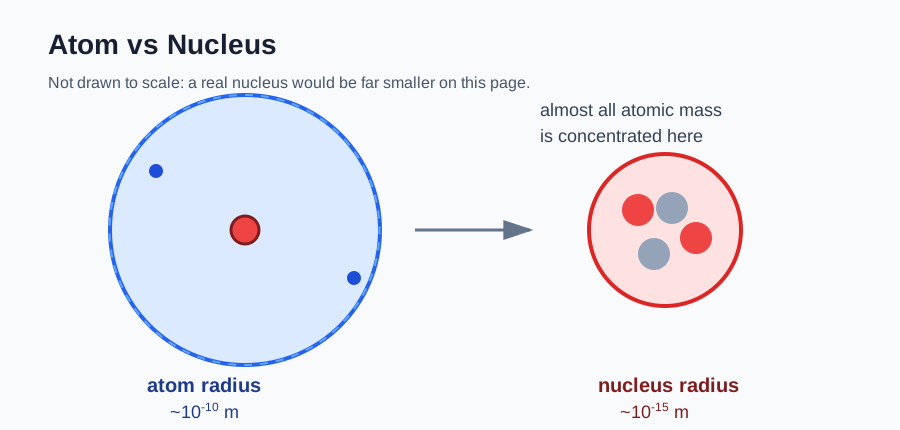 The nucleus is about $10^5$ times smaller in radius than the atom but contains almost all the atom's mass.
Rutherford Evidence
The Geiger-Marsden alpha-particle scattering experiment supports this picture:
- most alpha particles passed through thin gold foil undeflected or only slightly deflected
- a very small fraction were scattered through large angles
- some were scattered backwards
This shows that most of the atom is empty space, while the positive charge and most of the mass are concentrated in a tiny nucleus.
Nuclear Composition
The nucleus contains nucleons:
- protons
- neutrons
Key Numbers
- proton number:
- nucleon number, mass number:
- neutron number:
Meaning
- determines the element
- different gives different isotopes
- counts total nucleons
Nuclide Notation
A nuclide is written as:
where:
- = chemical symbol
- = nucleon number
- = proton number
Example:
- protons = 6
- neutrons = 8
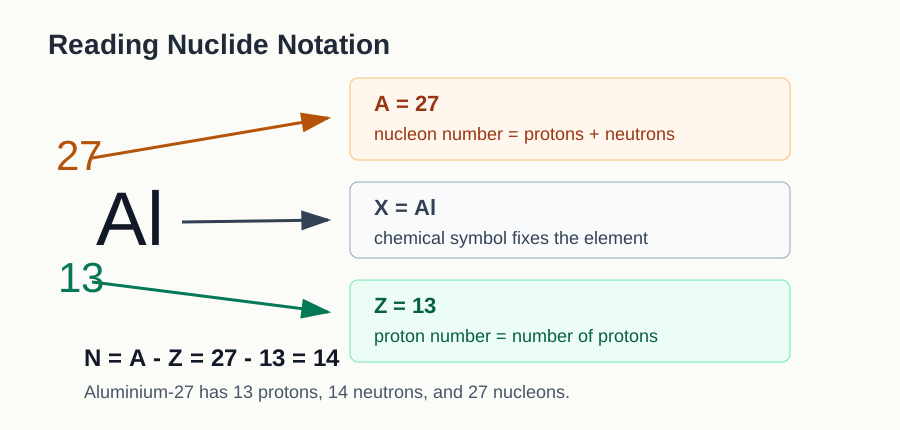 Nuclide notation gives $Z$ and $A$ directly, while neutron number is found from $N = A - Z$.
Isotopes
Isotopes are atoms of the same element with:
- same proton number
- different neutron number
Examples:
Important Notes
- same chemical behaviour if neutral
- different nuclear properties
- different masses
- some isotopes are radioactive
Do not confuse isotopes with ions. Isotopes differ in neutron number, while ions differ in electron number.
Nuclear Size and Density
Radius Relationship
Approximate nuclear radius:
where:
Implications
- larger nuclei have larger radius
- nuclear volume is proportional to
- since mass is also roughly proportional to , nuclear density is approximately constant for all nuclei
Nuclear density is very high compared with ordinary matter.
Strong Nuclear Force
Protons repel each other electrically, so another force must hold nuclei together.
Strong Nuclear Force
- attractive between nucleons
- very strong at short distances
- acts over very short range only
- stronger than electrostatic repulsion at nuclear distances
Consequence
Without the strong nuclear force, nuclei would fly apart.
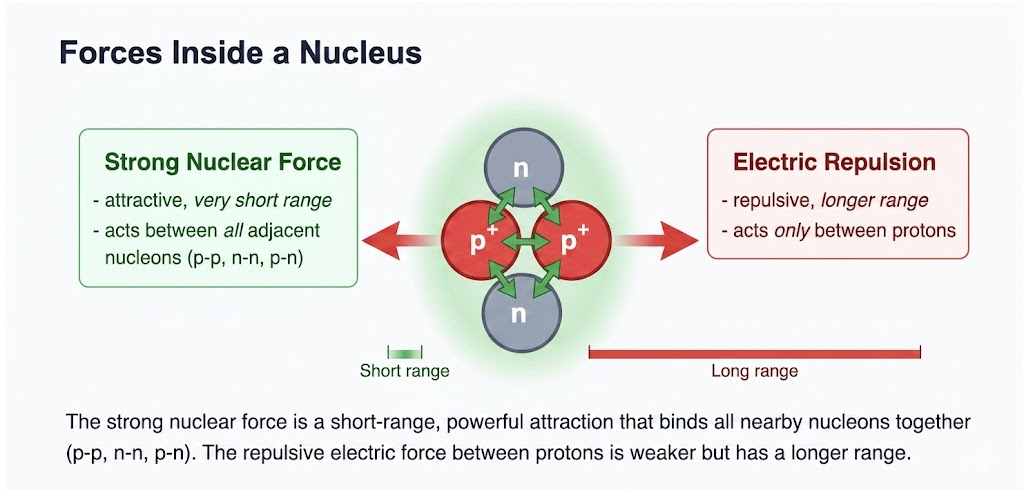 At nuclear distances, the short-range strong nuclear force can overcome proton-proton repulsion.
Stability and Neutron Number
Stable light nuclei tend to have similar numbers of protons and neutrons, so .
For heavier nuclei, stability usually requires more neutrons than protons:
Extra neutrons contribute attractive nuclear force without adding proton-proton electrostatic repulsion. However, for very large nuclei, the short-range nuclear force cannot fully compensate for the increasing long-range repulsion between many protons.
Mass Defect Overview
The mass of a nucleus is less than the total mass of its separate nucleons.
This missing mass is the mass defect.
This missing mass has been converted into binding energy.
See Mass Defect and Binding Energy.
Binding Energy Overview
Binding energy is the minimum energy needed to separate a nucleus completely into free nucleons.
Using Einstein’s relation:
So:
Meaning
Larger binding energy generally means a more tightly bound nucleus.
Binding Energy per Nucleon Overview
This is usually a better measure of nuclear stability than total binding energy.
Why
A heavy nucleus may have a large total binding energy simply because it contains many nucleons.
In nuclear reactions, the total number of nucleons is conserved. Therefore, comparing binding energy per nucleon helps us compare how tightly nucleons are bound on average in different nuclei.
If nucleons rearrange into nuclei with greater binding energy per nucleon, the total binding energy increases and energy is released.
Stability Overview
Trend
Binding energy per nucleon:
- increases rapidly for light nuclei
- peaks around the iron / nickel region, near
- decreases gradually for very heavy nuclei
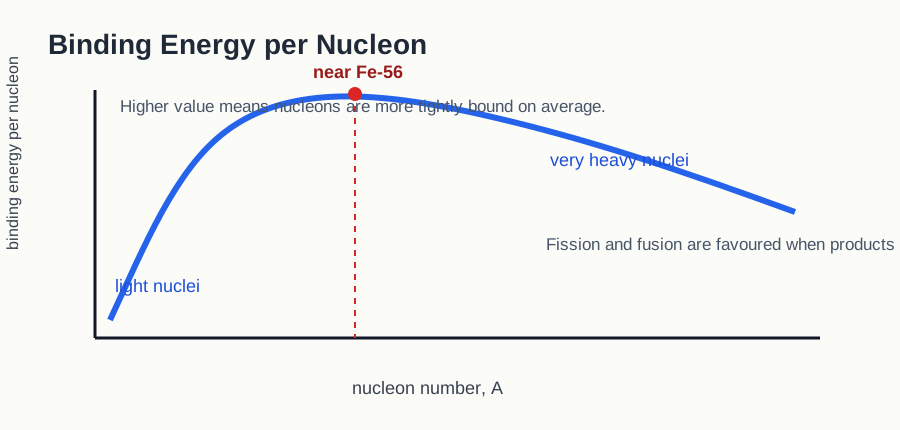 Binding energy per nucleon rises for light nuclei, peaks near iron-56, and falls gradually for very heavy nuclei.
Interpretation
- nuclei near the peak are the most stable
- very heavy nuclei may release energy by fission
- very light nuclei may release energy by fusion
This explains energy release in:
Link to Radioactive Decay
Some nuclei are unstable and decay spontaneously.
Examples include emission of:
- alpha particles
- beta particles
- gamma radiation
See Radioactive Decay.
Short Worked Examples
Example 1: Neutron Number
For:
Example 2: Identify Isotopes
Are and isotopes?
Yes.
- same
- different , so they have different neutron numbers
Example 3: Compare Stability
If nucleus X has greater binding energy per nucleon than nucleus Y:
- X is generally more stable
- nucleons in X are more tightly bound on average
Exam Relevance
Students should be able to:
- interpret nuclide notation correctly
- distinguish isotopes from ions
- explain the role of the strong nuclear force qualitatively
- relate mass defect to binding energy
- use binding energy per nucleon to discuss stability and energy release
Formula Sheet
Nuclear Composition
Radius
Mass-Energy
Binding Energy per Nucleon
Common Exam Traps Overview
Students often confuse:
- with
- atom mass with nucleus mass
- total binding energy with binding energy per nucleon
- larger nucleus with more stable nucleus
- isotope with ion
See Nuclear Physics Common Exam Traps.
Quick Revision Summary
- nucleus contains protons and neutrons
- = protons, = total nucleons
- isotopes have same , different
- strong nuclear force binds nucleons
- nuclear mass is less than the sum of separate nucleons
- missing mass gives binding energy
- stability depends strongly on binding energy per nucleon
Links
- Atomic Structure
- Quantum Physics
- Mass Defect and Binding Energy
- Radioactive Decay
- Nuclear Fission
- Nuclear Fusion
- Nuclear Physics Common Exam Traps
Provenance
- source file: 1_PDFsam_20_Nuclear-Physics.pdf
- generated by:
bridging_tools/ingest_JC_phy_wiki.py - manifest entry:
inbox/lecture_notes/1_PDFsam_20_Nuclear-Physics.pdf