Half-Life
Overview
Half-Life describes how radioactive substances decrease with time. It is a statistical measure of radioactive decay and one of the most important tools for solving nuclear-decay problems.
This topic connects directly with:
Core Ideas
- half-life is the time for an undecayed quantity to fall to half its value
- individual nuclei decay randomly, but large samples behave predictably
- decay constant measures the probability of decay per unit time
- undecayed nuclei, activity, and corrected count rate all decay exponentially with the same half-life
- background count rate must be subtracted before using count-rate data for half-life analysis
Connection to Radioactive Decay
Radioactive nuclei decay:
- spontaneously
- randomly
- independently of one another
Although individual nuclei decay unpredictably, a large sample behaves in a predictable way.
That predictable decrease gives rise to the idea of half-life.
Definition of Half-Life
The half-life of a radioactive nuclide is the time taken, for that nuclide, for:
- the number of undecayed nuclei to fall to half its original value
or equivalently:
- activity to fall to half its original value
- corrected count rate to fall to half its original value
Symbol:
Half-life is not the time for a sample to disappear. In equal half-life intervals, the same fraction of the remaining sample decays, not the same fixed amount.
Random Decay and Statistical Predictability
Individual Nucleus
It is impossible to know exactly when one nucleus will decay.
Large Sample
For many nuclei:
- average behaviour is highly predictable
- the sample follows the exponential decay law
This is why half-life is meaningful and measurable.
Decay Constant Overview
The decay constant is:
It represents the probability per unit time that a nucleus decays.
Unit:
Larger means:
- faster decay
- shorter half-life
Half-Life Relation
Therefore:
- large gives small half-life
- small gives long half-life
Decay Law Overview
Number of Undecayed Nuclei
where:
- = initial number
- = number remaining after time
Activity
Since activity is proportional to the number of undecayed nuclei:
and:
Count Rate
If detector geometry remains constant, the corrected source count rate, which is , follows:
where:
- = initial corrected source count rate
- = corrected source count rate at time
Undecayed nuclei, activity, and corrected count rate follow the same exponential decay shape.
Repeated Halving Method
After each half-life, the quantity halves.
| Time | Remaining Fraction |
|---|---|
This is useful when the time is an exact multiple of the half-life.
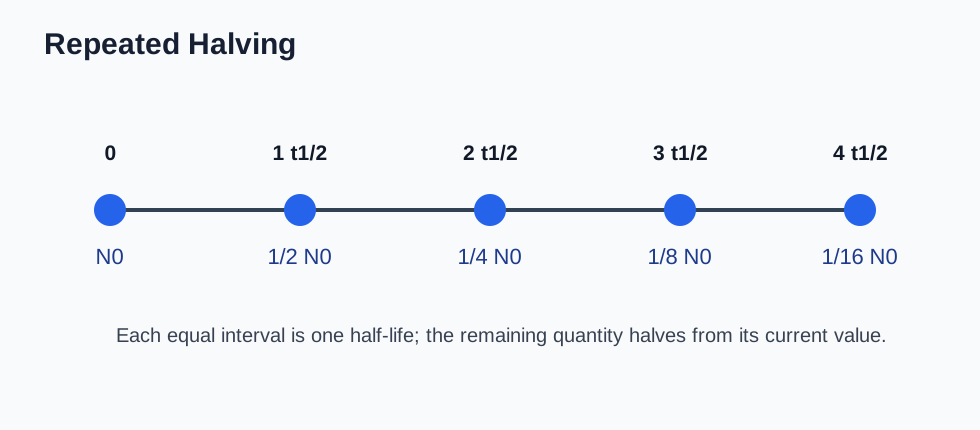
Equal half-life intervals halve the remaining radioactive quantity each time.
Activity, Count Rate and Nuclei Linkage
These three quantities are proportional:
- undecayed nuclei
- activity
- corrected count rate
So they all fall with the same half-life.
Here, corrected count rate means the source count rate after background count rate has been subtracted.
If halves:
- halves
- corrected halves
Background Count Overview
A detector often records background radiation.
Measured count rate:
Therefore:
Always subtract background before using count-rate data to determine half-life.
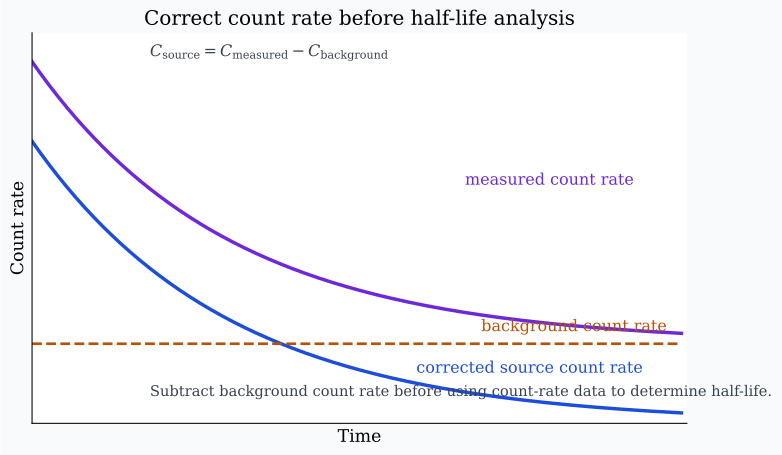
Subtract background count rate before using count-rate data to determine half-life.
Graph Overview
Decay graphs of:
- against
- against
- against
are exponential curves:
- steep at first
- flatten gradually
- never reach zero exactly
Measured count-rate graphs flatten towards the background count. Corrected source count-rate graphs flatten towards zero.
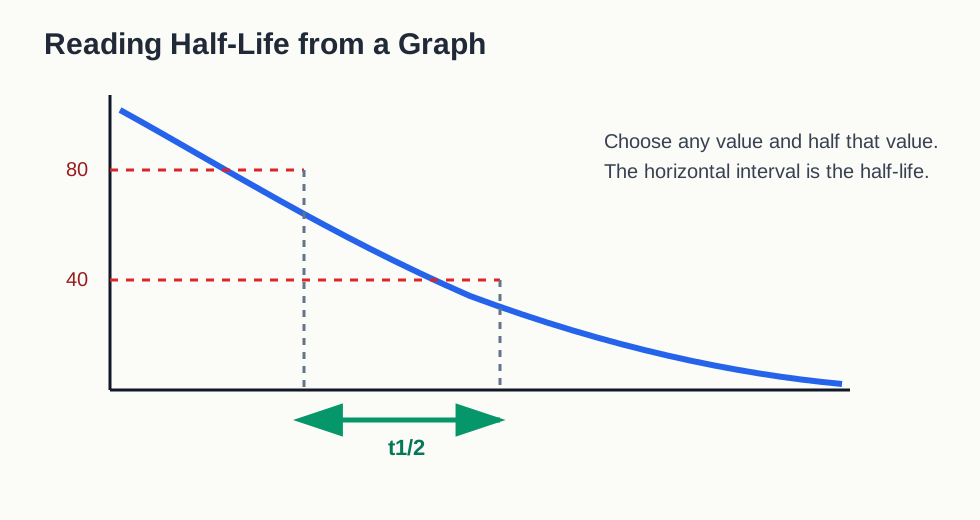
Half-life is the horizontal time interval for a decay graph to fall from any value to half that value.
See Exponential Decay and Graphs.
Short Worked Examples
Example 1: Repeated Halving
Half-life = 5 h
Initial activity = 800 Bq
After 15 h:
- 3 half-lives
Answer:
Example 2: Find Half-Life
A sample drops from 1200 Bq to 300 Bq in 8 h.
So there are two half-lives in 8 h.
Therefore:
Example 3: Background Count
Measured count rate = 90 counts min
Background count rate = 15 counts min
Corrected source count rate:
Use 75 for decay calculations.
Exam Relevance
Students should be able to:
- define half-life correctly for undecayed nuclei, activity, and corrected count rate
- distinguish random single-nucleus behaviour from predictable large-sample behaviour
- use repeated halving for simple calculations
- use exponential-decay relations and the half-life formula
- correct count-rate data for background before analysing graphs
Formula Sheet
Decay Law
Activity
Activity Decay
Count Rate Decay
Half-Life Relation
Common Exam Traps Overview
Students often confuse:
- half-life with complete disappearance
- random single decay with predictable sample decay
- activity with the number decayed
- measured count rate with corrected count rate
- repeated-halving steps
- the units and meaning of
See Half-Life Common Exam Traps.
Quick Revision Summary
- half-life is the time for a quantity to halve
- it applies to , , and corrected
- radioactive decay is random for one nucleus but predictable for many
- decay follows the exponential law
- larger decay constant means shorter half-life
- subtract background count before analysis