Electric Fields
Overview
This topic explains how charges exert forces at a distance and how the same physics can be described from both force and energy viewpoints.
The topic structure is:
- force between point charges
- electric field strength and direction
- field-line patterns and superposition
- electric potential and electric potential energy
- equipotentials and the potential-gradient relation
- charged-particle motion in uniform fields
- graph behaviour of , , and
Core Ideas
Electric-fields questions revolve around a small linked set of ideas:
- charges exert forces on one another
- electric field strength is force per unit positive charge
- electric field is a vector quantity
- electric potential is a scalar quantity
- potential energy depends on both location and test charge
- uniform fields give constant force and therefore constant acceleration
- graph shape matters as much as formula use
Exam Relevance
This topic is heavily tested through:
- direct substitution into Coulomb’s-law, field, potential, or energy formulas
- comparison of vector and scalar addition
- graph interpretation of , , and against distance
- charged-particle motion in uniform electric fields
- explanation questions involving direction, sign, and field-line reasoning
Coulomb’s Law
For two point charges separated by distance , the magnitude of the force is:
where: is the permittivity of free space.
It is important to recall that force is a vector. When two charges and interact with each other, the force on exerted by can be expressed as:
where is a unit vector pointing from to .
- the force acts along the line joining the charges
- the charge signs determine whether the force is attractive or repulsive
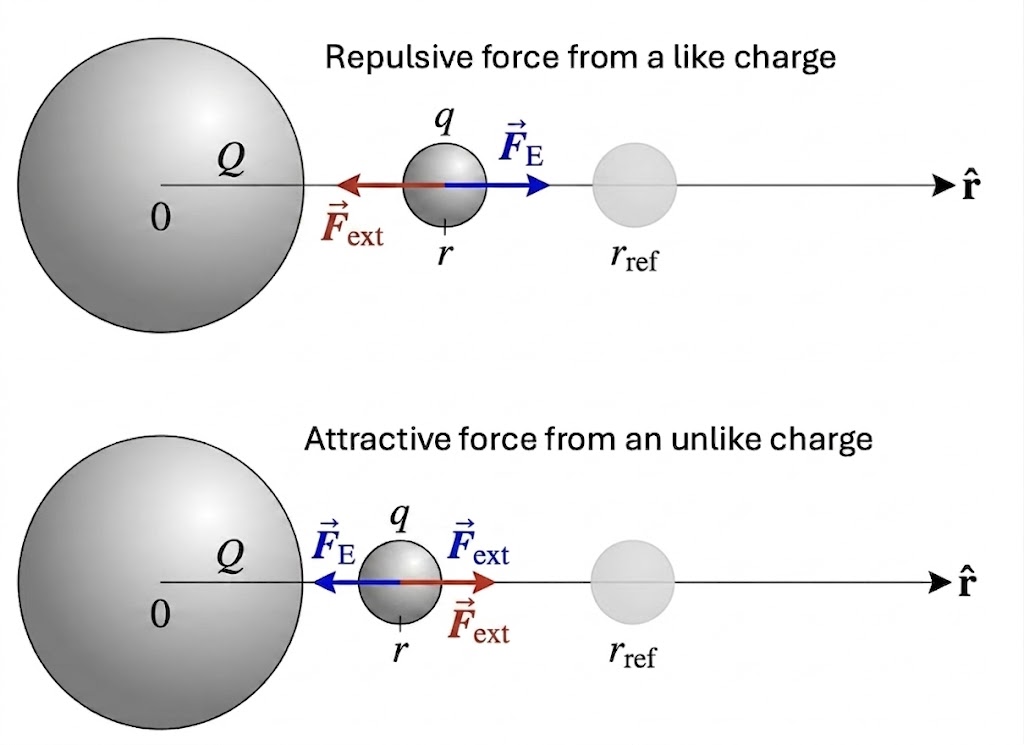
Figure 1. Electric force acts along the line joining two charges. Like charges repel, while unlike charges attract. This force would accelerate a free charge, such as in the figure. To keep the charges stationary, or moving with constant velocity, an external force of equal magnitude and opposite direction must be applied.
Meaning
- like charges repel
- unlike charges attract
- the magnitude falls as
Electric force on a test charge due to a source charge acts along the line joining them; the charge signs determine attraction or repulsion.
Using as the reference direction, Coulomb’s law can also be expressed in signed-scalar form for one-dimensional motion:
Electric Field Strength
Electric field strength at a point is the force per unit positive charge. In vector form:
Units:
- N C
- V m
For the field generated by a point charge , the vector form is:
where is a unit vector in the out-pointing radial direction from the position of . The field direction is defined as the direction of force on a positive test charge:
- away from positive source charges
- towards negative source charges
Superposition
If several charges act at a point:
This is a vector sum, so direction matters.
Electric Field Lines
Field lines are a visual model of the electric field.
Rules:
- start on positive charges
- end on negative charges
- never cross
- closer spacing means a stronger field
Common patterns:
- isolated positive charge: radially outward lines
- isolated negative charge: radially inward lines
- opposite charges: lines run from positive to negative
- like charges: lines curve away from the central region
- uniform field between parallel plates: parallel, evenly spaced lines
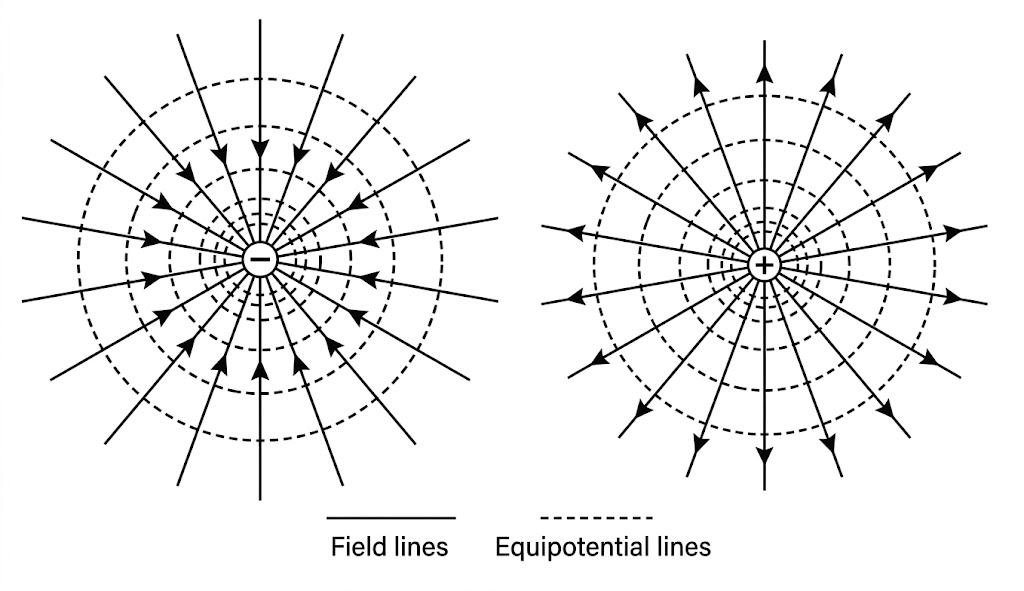 *Figure 2. Electric field lines and equipotential lines around isolated point charges. Field lines point radially outward from a positive charge and radially inward toward a negative charge. The dashed circular lines are equipotential lines; every point on the same dashed circle has the same electric potential. Electric field lines are always perpendicular to equipotential lines.*
Field lines show direction and relative strength; equipotentials are perpendicular to the field direction.
Electric Potential Energy and Electric Potential
Electric potential energy should be defined before electric potential.
A charge placed in an electric field experiences an electric force . If left free, it will accelerate. To move the charge without acceleration an external force must be applied to counterbalance the electric force:
The electric potential energy of the charge at position is defined as the work done by the external force in bringing the charge from infinity to that position without acceleration:
For a one-dimensional motion along a chosen line, this becomes:
where and are signed scalars, indicating the force and position along the chosen line with a reference positive direction.
Electric potential is the electric potential energy per unit positive test charge:
Equivalently, it is the work done per unit positive charge by an external agent in bringing a test charge from infinity to that point without acceleration.
Special Case: Field Due to a Point Charge
For the situation shown in Figure 1, the electric field is produced by a source charge . The test charge experiences an electric force along the line joining and .
If and have the same sign, the electric force on is repulsive. If they have opposite signs, the force is attractive. In either case, to move without acceleration, the external force must be equal in magnitude and opposite in direction to the electric force.
For a point charge , the electric potential energy at distance from can be shown as:
where is the distance from the source charge .
The electric potential of the two-charge system is therefore:
Electric potential is a scalar quantity, so potentials from several source charges add algebraically:
Sign Meaning
- like charges give positive potential energy
- unlike charges give negative potential energy
- this helps explain whether energy must be supplied or is released
Energy Change
For a charge moving between two points:
If only electric forces act:
See also Electric Potential and Energy.
Equipotentials and Potential Gradient
An equipotential surface is the set of points with the same electric potential.
Properties:
- no work is done moving a charge along an equipotential
- equipotentials meet field lines at right angles
- closer spacing means a larger potential gradient and therefore a stronger field
The key relation is:
For the magnitude of a uniform field between plates:
Equipotential lines are perpendicular to electric field lines, and closer spacing between equipotentials indicates a stronger electric field. For the electric field from a point charge, all points at the same distance from the charge have the same electric potential. Therefore, points of equal potential form concentric spherical surfaces, shown in cross-section as concentric circles in Figure 2.
Uniform Fields Between Parallel Plates
 Figure 3: Uniform electric field between oppositely charged parallel plates. The solid vertical arrows represent electric field lines directed from the positive plate to the negative plate. The dashed horizontal lines are equipotential lines, which are perpendicular to the electric field. Equal spacing of both field lines and equipotential lines indicates a uniform electric field with constant potential gradient.
Between oppositely charged parallel plates, the field in the central region is approximately uniform.
That means:
- constant field strength
- constant force on a charge
- constant acceleration for a charged particle
For a charge :
and:
Charged Particles in Electric Fields
Charged-particle motion can be treated using both energy and kinematics ideas.
Key cases
- a positive charge accelerates in the field direction
- a negative charge accelerates opposite the field direction
- a particle entering parallel to the plates keeps its horizontal velocity while accelerating vertically
- the path is parabolic
Typical relations
For a charged particle moving across a uniform field between two charged plates — the charged particle follows a parabolic path when horizontal motion combines with constant vertical acceleration.
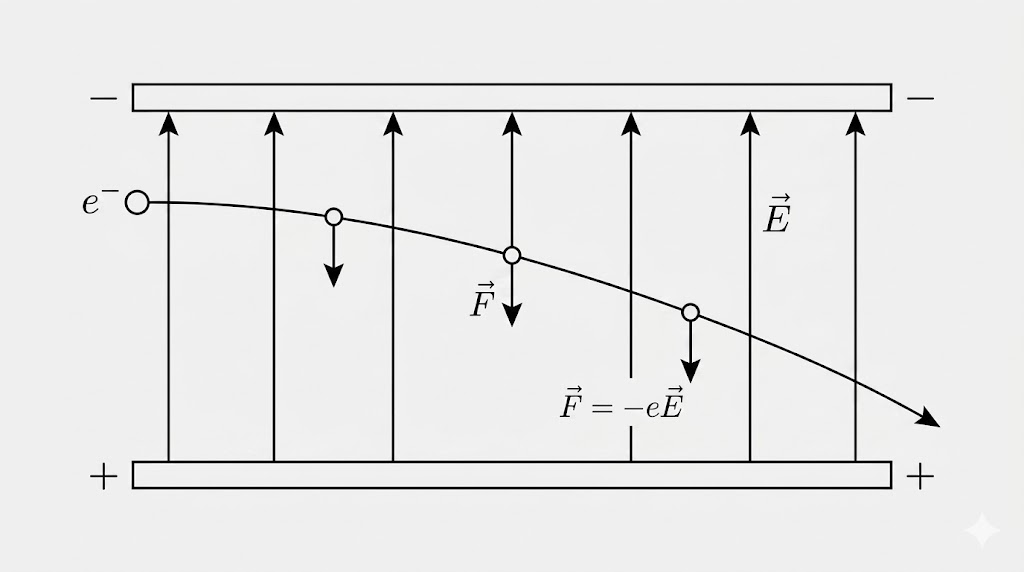 *Figure 4: Motion of an electron through a uniform electric field between oppositely charged parallel plates. The electric field $\vec{E}$ is directed upward from the positive plate to the negative plate. Since the electron carries negative charge, the electric force $\vec{F} = -e\vec{E}$ acts downward, opposite to the field direction. The electron therefore undergoes constant downward acceleration while maintaining horizontal motion, producing a parabolic trajectory.*
Graphs and Distance Trends
The main distance dependences are:
- with sign set by the charge pair
The graph lesson is not just about formulas. It is also about recognising that the gradient of a potential graph gives field strength, and the negative gradient of a potential-energy graph gives the force component along that axis.
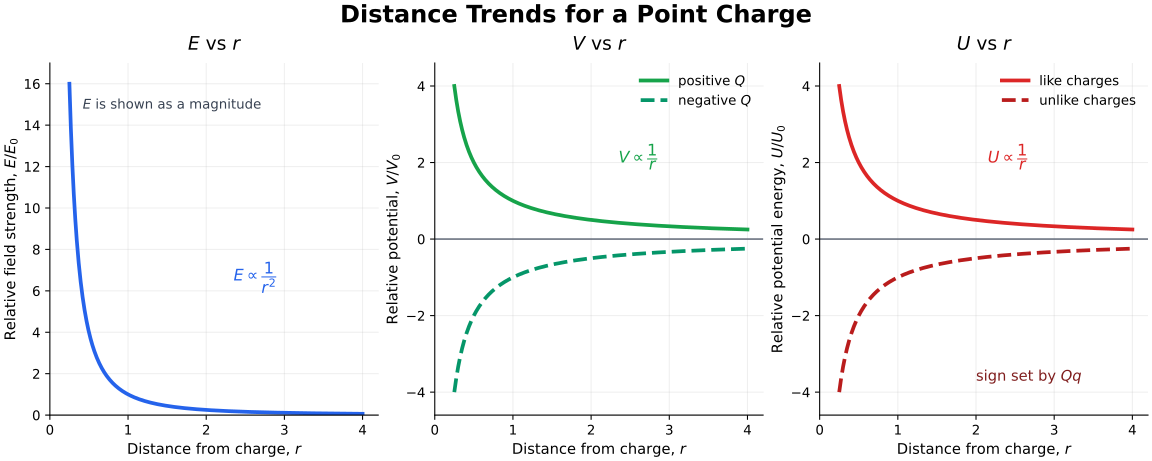
For a point charge, the field-strength magnitude falls as , while electric potential and potential energy vary as with signs set by the charges involved.
Comparison With Gravitational Fields
Electric and gravitational fields share:
- inverse-square force laws
- field strength as force per unit source quantity
- potential and potential-energy viewpoints
- superposition
Main differences:
- gravity acts on mass and is always attractive
- electric fields act on charge and can attract or repel
- electric potential can be positive or negative
See Gravitational vs Electric Fields.
Quick Revision Summary
- Coulomb’s law gives the force between point charges
- field strength is force per unit positive charge
- field lines show direction and strength
- potential is scalar; field is vector
- potential energy is
- equipotentials are perpendicular to field lines
- uniform fields give and constant acceleration
- charged particles in uniform fields follow parabolic paths if they enter sideways
Common Exam Traps
See Electric Fields Common Exam Traps for the compact checklist.